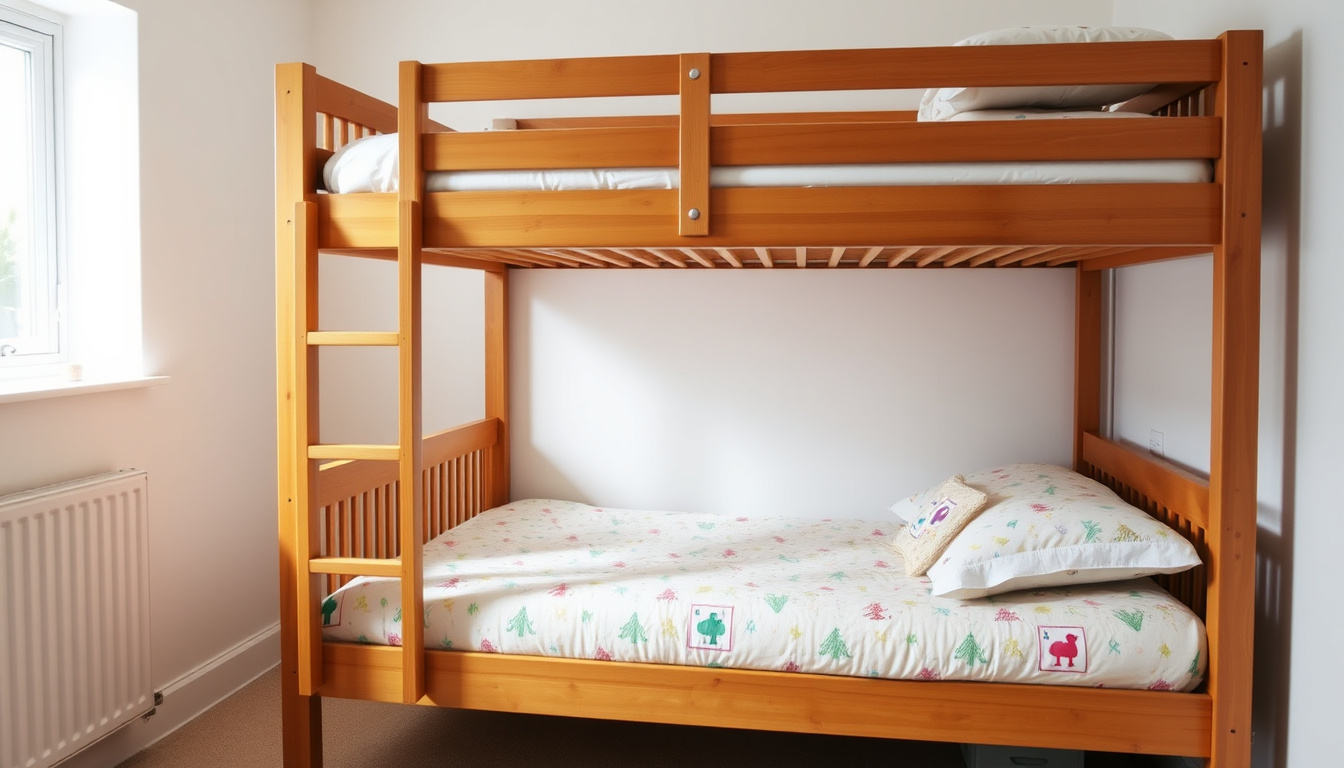
If you’ve got two kids sharing a room, you’ve probably wondered whether bunk beds are worth the space savings — and whether they’re actually safe for your little ones. The math on square footage is simple. The safety picture is more complicated, especially when you layer in Irish and EU regulations alongside guidance from health bodies on minimum ages. This guide breaks down exactly what those rules mean for Irish parents shopping for a bunk bed today.
CPSC Minimum Age: 6 years · Top Safety Concern: Falls from top bunk · Common Bunk Types: Double, Triple, Storage · Ireland Retailers: Ogelbeds, Des Kelly · Guide Availability: EZ Living Bunk Beds Guide
Quick snapshot
- Top bunk minimum age is 6 years per CPSC and echoed across EU guidelines (The Bean Bag Store)
- EN747 requires guardrails 16cm above the mattress in Ireland (MummyPages.ie)
- Slats must be no more than 7.5cm apart under EN747 standards (MummyPages.ie)
- Bunk Bed Entrapment Hazards Regulation introduced in September 1987 (MK Furnishings)
- BS EN 747-1:2024 updated to include tipping stability and mandatory age labelling (MK Furnishings)
- Parents should verify EN747 compliance before purchasing, particularly for older secondhand units
- New BS EN 747-1:2024 requirements will increasingly appear on Irish retailer listings
The table below maps primary regulatory sources against the specific safety claims cited throughout this guide.
| Field | Value | Source |
|---|---|---|
| CPSC Rule Source | Bunk Beds Business Guidance | CPSC.gov | CPSC.gov official guidance |
| Safety Guide | Bunk Bed Safety: What Parents Need to Know | MummyPages.ie |
| Safe Age Source | What Age is Safe for Bunk Beds? | Bamfo |
| Outgrow Info | When Will Your Child Outgrow Their Bunk Beds? | BunkBeds.co.uk |
| Irish Early Years Guidance | Tusla Early Learning and Care Sleep Guidelines | Tusla |
| EN747 Standard | EU regulation for bunk bed safety, strength, durability | MummyPages.ie |
| BS EN 747-1 Latest | 2024 edition with stability and labelling updates | MK Furnishings |
| Entrapment Regulation | 1987-09-01 effective date, bans 60-75mm gaps | MK Furnishings |
What age should a child sleep in a bunk bed?
The most contested question in bunk bed safety is the minimum age — and the answer splits by bunk position. The top bunk requires a child who can navigate a ladder safely and resist the urge to bounce or play when they should be asleep. The bottom bunk is a different story.
Safety guidelines from CPSC
The US Consumer Product Safety Commission (CPSC) sets the most cited benchmark: children under 6 should never sleep on the top bunk (The Bean Bag Store citing CPSC). This guidance carries weight in Ireland because it aligns with both EN747 requirements and advice from UK health bodies whose standards Irish retailers often reference. The American Academy of Pediatrics reinforces this position based on injury data showing that children under 6 lack the coordination to avoid falls from elevation.
The Bunk Bed (Entrapment Hazards) Regulation of 1987 addresses the physical construction of bunks — specifically banning gaps between 60mm and 75mm in bed frames where a child’s body could become trapped (MK Furnishings). This regulation applies to beds with a sleeping surface at least 800mm above ground, and applies in Ireland through EU harmonisation. The 2024 update to BS EN 747-1 builds on this foundation by adding requirements for stability against tipping and mandatory age labelling on packaging.
Recommendations for 3-5 year olds
For children aged 3 to 5, the bottom bunk is generally considered appropriate with supervision, while the top bunk remains off-limits until age 6 (Bamfo). Some guidelines suggest that lower bunks positioned no more than 30 inches from the floor may not require guardrails, since the fall distance is reduced. However, guardrails are still advisable for younger children regardless of bunk height.
For Irish parents with a 4 or 5-year-old, the bottom bunk is fine — with a guardrail and a conversation about ladder safety. The top bunk waits until 6, no exceptions.
Tusla’s guidance for Irish early learning settings recommends individual sleep mats or stackable beds for children under 3, but does not specify bunk bed rules for that age group (Tusla). This reflects the general consensus that bunk beds are not appropriate for children under 4 at all, and not appropriate for top bunks until 6.
The pattern across CPSC, EN747, and RoSPA is consistent: age 6 is the hard floor for top bunk access, and that line exists because developmental readiness — not physical size — determines whether a child can manage the ladder and resist impulsive behaviour during sleep.
Should a 4 year old have a bunk bed?
A 4-year-old occupies a grey zone in bunk bed recommendations. They’re typically old enough for the bottom bunk but still too young for the top. Whether a bunk bed makes sense at this age depends on whether your child will have access to the top bunk unsupervised.
Risks for under 6
Children under 6 face elevated risks on bunk beds for several reasons tied to developmental stage rather than physical size. Coordination is still developing, meaning a child this age may stumble on the ladder rungs or roll over in sleep without waking. The CPSC and AAP both flag that children under 6 lack the judgment to refrain from play behaviour on elevated surfaces, including jumping and climbing on guardrails (The Bean Bag Store).
The injury data is stark: reportedly half of bunk bed injuries occur in children under 6 (The Bean Bag Store). While this figure comes from tier3 sources and should be treated with appropriate caution, it aligns with the broader pattern that younger children are disproportionately represented in fall-related injuries.
Alternatives to bunk beds
For parents of children under 6 who want to maximise space, alternatives include a mid-sleeper with a play area underneath, two separate beds pushed together or perpendicular to save space, or a loft bed where the lower level is play space rather than a sleeping area. Bunk beds suited to ages 4-16 overall, with the top bunk from 6+, represent the broadest practical window (Dreams).
A bunk bed for a 4-year-old means committing to bottom-bunk-only use for at least two years. If the top bunk will sit empty, you’re paying for space you can’t use yet.
What this means for Irish parents is straightforward: if your youngest child is under 6, factor in at least two years of single-bunk utility before the purchase pays off in actual shared sleeping.
What are the disadvantages of bunk beds?
Bunk beds save floor space and make sleepovers possible, but they come with trade-offs that go beyond the obvious assembly headache.
Safety risks
The primary safety risks are falls and entrapment. Falls from the top bunk account for the majority of bunk bed injuries, particularly when guardrails are missing, damaged, or positioned incorrectly. EN747 requires guardrails to rise at least 16cm above the mattress height and to enclose the sleeping area with an entry gap no greater than 30cm (MummyPages.ie). Entrapment risks emerge from gaps in the frame — particularly the 60-75mm range that the 1987 regulation specifically bans (MK Furnishings).
Ladder-related injuries are a distinct category. The treads must be at least 3cm wide and spaced no more than 20cm apart under BS EN standards (Strictly Beds & Bunks). Narrow or widely spaced rungs increase the fall risk during middle-of-the-night trips to the bathroom. A night light near the ladder is widely recommended to reduce these incidents (MK Furnishings).
Space and access issues
The top bunk occupant faces inherent access challenges. They must climb a ladder to go to bed and to get up, which becomes problematic during illness, night terrors, or emergencies. The top bunk mattress depth should be 6-7 inches to ensure the guardrail remains effective height above the sleeping surface (BunkBeds.co.uk). Deeper mattresses reduce the effective guardrail height and create fall risk.
Weight limits of 75-100kg per bunk apply per manufacturer guidelines (Dreams). This means bunk beds are not suitable for adult use in most cases, limiting their lifespan once children grow. Only one child per bunk at a time is the firm rule across all safety guidelines — a restriction that may surprise parents expecting siblings to share a single bunk during sleepovers.
The implication for families is that bunk beds are a time-limited solution: the window between a child being old enough for the top bunk and too old or heavy to use it comfortably can be surprisingly narrow.
What is the bunk bed rule?
The phrase “bunk bed rule” typically refers to the regulatory framework governing their construction and sale, not a single law. In Ireland, the relevant standards are EN747 and its British counterpart BS EN 747-1:2024.
CPSC regulations
The CPSC requires warning labels on all bunk beds sold in the United States, specifically prohibiting children under 6 from sleeping on the top bunk (Lullabye Shop). While the CPSC does not directly regulate Irish sales, its standards influence manufacturers producing for global markets, including those selling in Ireland. Federal US warnings prohibit under-6 upper bunk use, aligned with the EU age 6+ position.
Labeling and guardrail rules
BS EN 747-1:2024 introduced mandatory age labelling — products must clearly state the minimum age for top bunk use (MK Furnishings). This is a practical addition that helps parents buying online or without specialist knowledge. Guardrail requirements under EN747 are precise: rails must rise 16cm above the mattress surface, with no gap exceeding 30cm at the entry point (MK Furnishings).
When buying a secondhand bunk bed, check for compliance with current BS EN 747-1:2024 standards. Pre-2024 models may lack mandatory age labelling and updated stability requirements.
The catch for Irish buyers is that not all retailers display standard version numbers — so asking explicitly whether a product meets 2024 requirements can save you from taking home an older unit with outdated safety features. For Irish buyers, checking for compliance with current BS EN 747-1:2024 standards is crucial, and you can find more information on bunk bed safety for Irish parents at $Squash courts in Ireland.
At what age do kids stop wanting bunk beds?
The practical lifespan of a bunk bed is wider than many parents expect, but the teenage years bring a reckoning.
Outgrowing phase
Bunk beds are generally suited to children aged 4-16, with the top bunk appropriate from age 6 onwards (Dreams). However, the upper age limit depends on weight capacity, room dynamics, and social acceptance. Once children hit early adolescence, the appeal of a bunk bed often diminishes — classmates may visit, and the novelty of sleeping stacked becomes less attractive than having a standard bed.
The exact outgrow age varies by individual development rather than a strict calendar threshold (Bamfo). Some children are ready for a standard bed by age 8 or 9; others happily use bunks until early teens. Height and weight become practical constraints when a child approaches the 75-100kg weight limit per bunk.
Transition tips
When the time comes to transition, consider converting the bunk bed into two separate standard beds if the frame allows, or using the lower section as a daybed or sofa. Many bunk beds designed for younger children don’t convert, making them a shorter-term purchase than they may appear at point of sale.
The pattern suggests that families treating bunk beds as a 10-12 year investment may be overestimating utility — the social pressure often arrives before the weight limit does.
Bunk bed safety: what we know and what we don’t
Across the available research, certain facts appear consistently from multiple sources while others remain contested or unverified.
Confirmed facts
- Top bunk minimum age is 6 years per CPSC and echoed by NHS, RoSPA, and EU guidelines
- EN747 mandates guardrails at least 16cm above mattress height
- Slat spacing must not exceed 7.5cm under EN747
- Ladder treads must be at least 3cm wide, spaced 20cm apart
- The 1987 Entrapment Regulation bans 60-75mm gaps in bed frames
- Weight limits typically range 75-100kg per bunk
- BS EN 747-1:2024 requires age labelling on packaging
What remains unclear
- No dedicated Irish government primary source on home bunk bed purchases
- Ireland-specific injury statistics are limited
- Exact outgrow age varies by individual child development
- Whether Tusla will issue specific bunk bed guidance for home settings
The specification table below consolidates the regulatory requirements that Irish parents should verify before purchasing any bunk bed.
| Specification | Requirement | Source Standard |
|---|---|---|
| Top Bunk Minimum Age | 6 years | CPSC, EN747, NHS, RoSPA |
| Bottom Bunk Minimum Age | 4 years (with supervision) | Bamfo, RoSPA |
| Guardrail Height | 16cm above mattress | EN747, BS EN 747-1:2024 |
| Maximum Slat Spacing | 7.5cm | EN747, BS EN 747:2015A |
| Minimum Tread Width | 3cm | BS EN 747-1:2024 |
| Maximum Tread Spacing | 20cm | BS EN 747-1:2024 |
| Banned Entrapment Gaps | 60-75mm | Bunk Bed (Entrapment Hazards) Regulation 1987 |
| Weight Limit Per Bunk | 75-100kg | Manufacturer guidelines (Dreams) |
| Top Bunk Mattress Depth | 6-7 inches maximum | BunkBeds.co.uk |
| Entrapment Regulation Effective Date | 1987-09-01 | MK Furnishings |
| Current EN Standard | BS EN 747-1:2024 | MK Furnishings |
| Age Labelling Requirement | Mandatory on packaging | BS EN 747-1:2024 |
Pros and cons of bunk beds for kids
Upsides
- Maximises floor space in small bedrooms
- Sleepover-friendly for siblings or guests
- Appeal to children — the novelty factor is real
- Available in double, triple, and storage configurations from Irish retailers
- Compliant units meet rigorous EN747 structural standards
- Bottom bunk suitable from age 4, giving 2+ years of use before top bunk access
Downsides
- Top bunk unsafe for under 6 — age restriction limits use window
- Falls and entrapment risks require vigilance and maintenance
- Night-time trips to bathroom involve ladder climbing
- Weight limits (75-100kg) exclude adult use and restrict lifespan
- One child per bunk — no sharing a single bunk during sleepovers
- Depth of mattress affects guardrail effectiveness
- Social dynamics may make older children resist the arrangement
What the authorities say
Children under 6 years old should never sleep on the top bunk.
— Consumer Product Safety Commission (CPSC) guidance, cited via The Bean Bag Store
No child under the age of six should be allowed to sleep on the top bunk.
— Royal Society for the Prevention of Accidents (RoSPA), via BunkBeds.co.uk
Children must be at least 6 years old before sleeping on the top bunk, as advised by the NHS and RoSPA.
— MK Furnishings (furniture safety expert), Ireland market
Related reading: Harvey Norman Fountain Gate – Location, Hours and Contact Guide · Harvey Norman Thomastown – Address, Hours, Phone and Directions
rafa-kids.com, littlefolksfurniture.co.uk, strictlybedsandbunks.co.uk
Irish parents maximising small bedrooms often pair safety-compliant bunk beds with bunk beds with storage guide to free up play space below.
Frequently asked questions
Is a 3 year old big enough for a bunk bed?
No. Children under 6 should not sleep on the top bunk, and most guidelines recommend that children under 4 should not use bunk beds at all without constant supervision at the lower level. A 3-year-old’s coordination and judgment are not sufficient for safe bunk bed use, particularly when navigating the ladder.
Is it safe for a 5 year old to have a bunk bed?
A 5-year-old can use the bottom bunk with appropriate guardrails, but should not access the top bunk until age 6. Supervision and a clear household rule that the top bunk is off-limits are essential if the bunk bed is in a shared room where an older sibling uses the top.
Is it safe to put a 4 year old in a bunk bed?
A 4-year-old can use the bottom bunk of a properly constructed bunk bed meeting EN747 standards. The guardrail should be in place, the ladder treads should be at least 3cm wide and spaced no more than 20cm apart, and the child should understand that the top bunk is not for them yet.
From what age can a child sleep in a bunk bed?
The bottom bunk is generally considered safe from age 4 with supervision, while the top bunk requires a minimum age of 6. These age thresholds are consistent across CPSC, EN747, NHS, and RoSPA guidance.
Are bunk beds safe for young children?
Bunk beds are safe when they comply with EN747 and BS EN 747-1:2024, are used within age and weight limits, and include proper guardrails and ladder specifications. Unsafe gaps (60-75mm), missing guardrails, and use by children under 6 on the top bunk are the primary risk factors.
What safety features do bunk beds need?
EN747-compliant bunk beds must have guardrails at least 16cm above the mattress, slat spacing no greater than 7.5cm, ladder treads at least 3cm wide spaced no more than 20cm apart, and no gaps between 60-75mm where entrapment could occur. The BS EN 747-1:2024 update also requires mandatory age labelling on packaging.
Best bunk beds for kids in Ireland?
Irish retailers including Ogelbeds, Des Kelly, and Harvey Norman offer bunk beds that comply with EN747 standards. When evaluating options, look for BS EN 747-1:2024 compliance, explicit age labelling, guardrail specifications, and weight limits matching your children’s current sizes.
For Irish parents weighing up bunk beds, the decision comes down to this: two years of bottom-bunk-only use for a 4 or 5-year-old may not justify the purchase price, but for families with children aged 6 and over who share a room, a properly certified bunk bed meeting BS EN 747-1:2024 is a practical, space-efficient choice. The safety gap closes significantly once the youngest occupant is old enough for the top bunk. Verify EN747 compliance before buying, check the guardrail height and slat spacing against the standards above, and make sure the weight limit accommodates your children now and for the years ahead.

Grace Clarke leads fact-checking, source verification and corrections at Aussie Brief.