
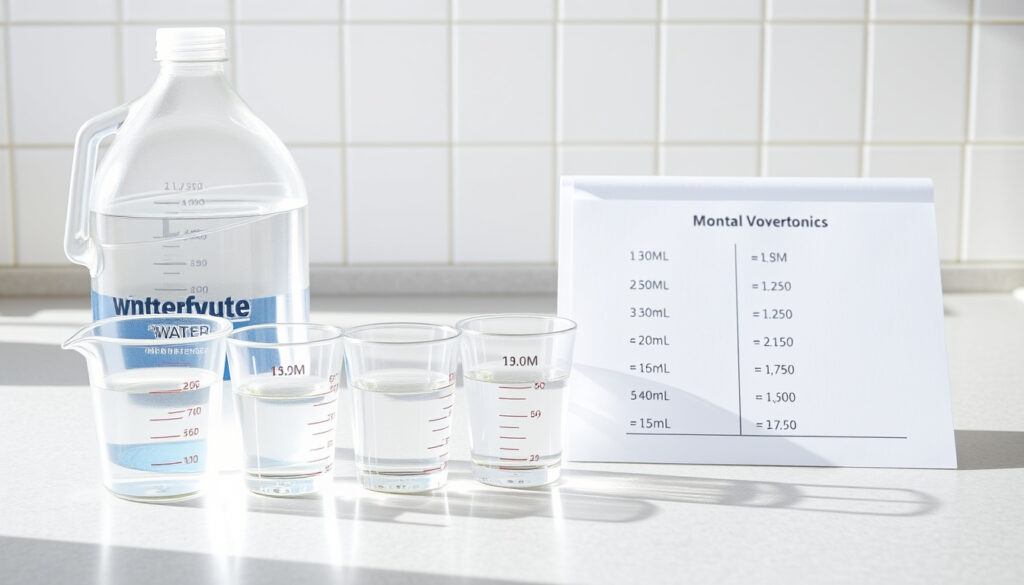
Converting liters to milliliters is one of the most common volume conversions in the metric system. Whether you’re measuring ingredients in the kitchen, calculating liquid doses in healthcare, or working through science problems, understanding the relationship between these two units is essential. The conversion follows a straightforward rule that remains constant across all standard measurements.
One liter equals exactly one thousand milliliters. This precise ratio makes calculations quick and reliable, with no need to account for temperature variations or liquid types. The following guide provides a complete overview of the conversion process, including practical examples, reference charts, and tools to simplify your calculations.
How Many Milliliters Are in 1 Liter?
The answer to this fundamental question is precise and unchanging: 1 liter equals 1000 milliliters. This relationship is defined by the International System of Units (SI), where the liter serves as a base unit of volume and the milliliter functions as its one-thousandth subdivision. The conversion factor of 1000 applies universally, regardless of whether you’re measuring water, milk, juice, or any other liquid.
1 L = 1000 mL — multiply liters by 1000 to obtain milliliters
Core Conversion Overview
| Conversion Factor | Value |
|---|---|
| Liters to Milliliters | Multiply by 1000 |
| Milliliters to Liters | Divide by 1000 |
| 1 Milliliter equals | 1 cubic centimeter (cm³) |
| 1 Liter equals | 1 cubic decimeter (dm³) |
Key Insights
- The liter-to-milliliter ratio never changes: exactly 1000 mL per liter
- This conversion applies equally to all standard liquids, including milk
- The milliliter is defined as one cubic centimeter, making volume calculations consistent
- The conversion requires multiplication only (no addition or subtraction)
- The metric system’s decimal structure simplifies scaling between units
Do You Multiply or Divide to Convert L to mL?
To convert liters to milliliters, you multiply by 1000. This is because the milliliter is a smaller unit than the liter—converting from a larger unit to a smaller unit requires multiplication. When converting in the opposite direction, from milliliters to liters, you would divide by 1000 instead.
The reason multiplication works lies in the metric system’s decimal structure. Each step down from liters to milliliters involves three decimal places. Moving from 1 liter to milliliters means accounting for three additional zero places: 1.000 liters becomes 1000 milliliters. This pattern holds true for any value, whether you’re converting 0.5 liters or 10 liters.
Multiply when going L → mL. Divide when going mL → L. The operation reverses when converting in the opposite direction.
The Conversion Formula
The formula for converting liters to milliliters is straightforward:
mL = L × 1000
For reverse conversions, use:
L = mL ÷ 1000 or L = mL × 0.001
L to mL Conversion Chart
The following chart provides verified conversion values for common liter measurements. These figures are based on the standard formula where each liter value is multiplied by 1000 to produce the milliliter equivalent.
| Liters (L) | Milliliters (mL) |
|---|---|
| 0.1 | 100 |
| 0.2 | 200 |
| 0.5 | 500 |
| 0.75 | 750 |
| 1 | 1000 |
| 1.5 | 1500 |
| 2 | 2000 |
| 2.5 | 2500 |
| 5 | 5000 |
| 5.75 | 5750 |
| 10 | 10,000 |
Milliliters to Liters Chart
| Milliliters (mL) | Liters (L) |
|---|---|
| 100 | 0.1 |
| 500 | 0.5 |
| 1000 | 1.0 |
| 2000 | 2.0 |
For those requiring conversions beyond these values, charts extend to larger quantities such as 100 liters (100,000 mL) and 1000 liters (1,000,000 mL). Printable conversion tables are available from educational resource providers to assist with manual calculations.
L to mL Calculator and Formula
Online conversion tools offer instant calculations for any liter value. These calculators operate by automatically applying the multiplication formula—entering a value in liters and receiving the equivalent milliliters immediately. The process eliminates manual calculation errors and provides results for fractional values as well.
To perform the calculation manually, simply multiply your liter value by 1000. For example, if you have 3.5 liters, the calculation would be 3.5 × 1000 = 3500 milliliters. This same principle applies regardless of the magnitude—larger values like 25 liters yield 25,000 milliliters using the identical formula.
When working with decimal values, ensure you account for all places correctly. Values like 0.75 liters require attention to the decimal position to produce accurate results.
Using Online Tools
Conversion calculators available through educational platforms allow you to input custom values and receive instant results. These tools are particularly useful when dealing with recipe measurements, laboratory quantities, or industrial applications where precision matters. Many platforms also offer reverse conversion functions for switching between milliliters and liters.
Common L to mL Conversions (Examples)
Practical examples demonstrate how the conversion formula applies to everyday situations. These calculations follow the established rule of multiplying liters by 1000.
Specific Conversion Examples
- 0.1 L to mL: 0.1 × 1000 = 100 mL
- 0.9 L to mL: 0.9 × 1000 = 900 mL
- 1 L to mL: 1 × 1000 = 1000 mL
- 10 L to mL: 10 × 1000 = 10,000 mL
Real-World Applications
In cooking and food preparation, these conversions appear frequently. A standard 2-liter milk carton contains 2000 milliliters, while a half-liter serving equals 500 milliliters. Recipe measurements often require precise conversions between these units, particularly when scaling portions or following international recipes that use metric measurements.
The same principles apply in healthcare settings where medication doses are measured in milliliters but larger containers are labeled in liters. Understanding the relationship helps ensure accurate measurements regardless of the unit displayed on packaging. Scientific laboratories similarly rely on these conversions for solution preparation and experimental procedures.
Understanding the Metric System Context
The liter and milliliter exist within the International System of Units, a globally standardized measurement framework. The liter is defined as exactly one cubic decimeter (dm³), while the milliliter corresponds to one cubic centimeter (cm³). This precise definition means the 1000:1 ratio is not an approximation but an exact mathematical relationship established by international agreement.
Standards bodies including the National Institute of Standards and Technology (NIST) and the International Bureau of Weights and Measures (BIPM) maintain the official definitions that ensure consistency worldwide. These organizations guarantee that a liter measured in the United States equals a liter measured in Europe or Japan, with no variation in the conversion factor.
The metric system’s decimal-based structure extends beyond volume to include other measurements like grams for mass and meters for length. This consistency means that once you understand the liter-to-milliliter relationship, converting between other metric units follows similar multiplication or division patterns.
Every liter is a thousand milliliters. The metric system is designed so that these relationships remain constant and predictable across all measurements.
— Khan Academy educational resources on metric volume conversions
What Is Certain and What Remains Unclear
| Established Information | Unchanged Parameters |
|---|---|
| 1 L = 1000 mL (exact ratio) | Applies under standard conditions |
| Formula: mL = L × 1000 | No variation for liquid type |
| SI-defined relationship | Universal for all standard measurements |
| Milliliter = 1 cm³ | Temperature-independent definition |
The conversion factor between liters and milliliters represents one of the most precisely defined relationships in measurement science. Unlike conversions involving temperature-dependent density or pressure adjustments, the liter-to-milliliter ratio remains constant. No special conditions, standard temperatures, or reference materials are required—the relationship holds exactly as defined regardless of context.
Educational Resources and Tools
Students and professionals alike can access various resources to strengthen their understanding of metric volume conversions. Khan Academy offers video lessons covering unit conversions with step-by-step examples, including demonstrations of multiplying by 1000 to shift between liters and milliliters. These educational materials cater to different grade levels and learning styles.
YouTube provides visual demonstrations through channels like PBS LearningMedia, which offers interactive lessons on liquid volume measurement. These resources use charts, animations, and practical examples to illustrate the conversion process for learners in grades 5 through 8. Printable conversion tables are also available through educational platforms for classroom and home use.
For those exploring related culinary topics, understanding liquid measurements connects to recipe development and nutritional considerations. High-protein ingredients often require precise liquid ratios during preparation, making accurate volume conversions particularly valuable in the kitchen.
Summary
Converting liters to milliliters requires multiplying by 1000, producing an exact result that applies universally across all standard measurements. The formula mL = L × 1000 provides the foundation for conversions ranging from tiny quantities like 0.1 liters to large volumes like 10 liters. This consistent relationship, defined by the International System of Units, ensures accuracy in cooking, healthcare, science, and everyday applications. Online calculators and conversion charts supplement manual calculations, while educational resources from Khan Academy and similar platforms support learning for students at various levels.
Frequently Asked Questions
How many milliliters are in a liter?
There are exactly 1000 milliliters in 1 liter. This conversion factor never changes.
Do you multiply or divide to convert liters to milliliters?
You multiply by 1000. Since milliliters are smaller than liters, multiplication is required when converting from larger to smaller units.
What is 0.9 liters in milliliters?
0.9 liters equals 900 milliliters (0.9 × 1000 = 900).
What is 10 liters in milliliters?
10 liters equals 10,000 milliliters (10 × 1000 = 10,000).
How do you convert milliliters back to liters?
Divide the milliliter value by 1000, or equivalently multiply by 0.001.
Does the conversion change for milk or other liquids?
No. The liter-to-milliliter ratio applies equally to all standard liquids, including milk, water, and juice.
What is the abbreviation for milliliter?
The abbreviation for milliliter is “mL” (uppercase L to avoid confusion with the number one).
Related stories





Liam O'Brien covers Australian politics and public affairs for Aussie Brief.