
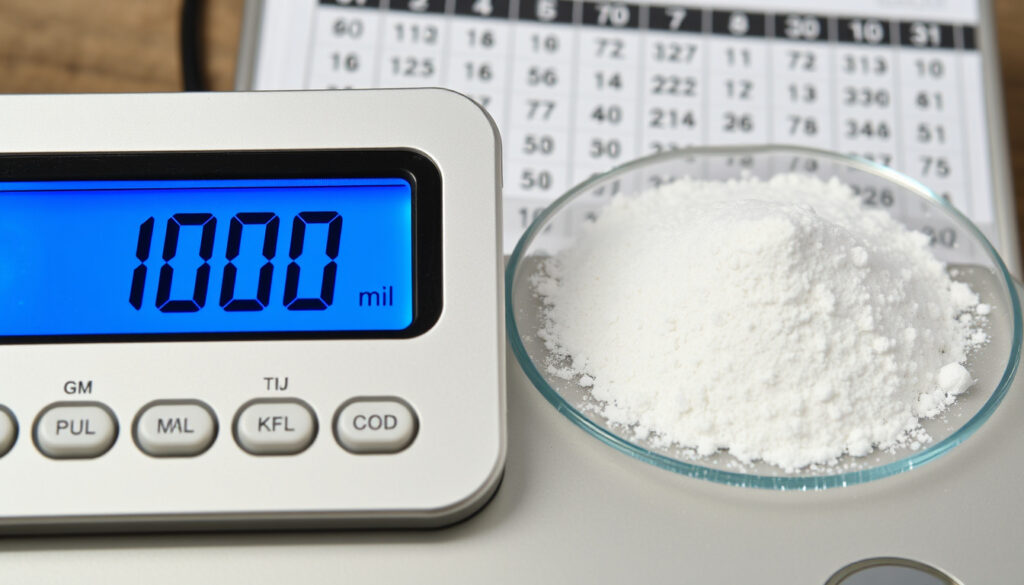
Anyone who has ever measured out a dose of medicine or weighed a chemical reagent knows that small numbers matter. The difference between milligrams and grams can change a dosage by a factor of a thousand. That’s why getting the conversion right — using the rule that 1 mg equals 0.001 g — is a basic skill with serious consequences. This guide walks through the formula, common mistakes, and real-world applications so you never misplace a decimal.
1 mg to g: 0.001 g ·
1 g to mg: 1000 mg ·
Formula mg → g: ÷ 1000 ·
Formula g → mg: × 1000
Quick snapshot
- 1 g = 1000 mg (NIST U.S. metrology authority)
- Convert mg to g by dividing by 1000 (RapidTables conversion tool)
- Prefix milli- means 1/1000 (Encyclopaedia Britannica science reference)
- Exact historical origin of metric definitions (not needed for practical use)
- Non-metric conversion factors (only the metric system is covered here)
- Decimal-point medication errors documented since the 1990s (Institute for Safe Medication Practices (ISMP))
- FDA continues to warn about unit confusion (U.S. FDA drug safety regulator)
- Use conversion chart for medicine dosing and lab work
- Apply mg → g conversion in chemistry molarity calculations
Six key conversion values, one pattern: each step up in whole hundreds moves the decimal two places.
| Label | Value |
|---|---|
| 1 mg to g | 0.001 g |
| 1 g to mg | 1000 mg |
| Conversion formula mg to g | Divide by 1000 |
| Conversion formula g to mg | Multiply by 1000 |
| 500 mg to g | 0.5 g |
| 1000 mg to g | 1 g |
Is 1 gram 1000 mg?
The exact relationship between grams and milligrams
Yes — 1 gram is exactly 1000 milligrams. This isn’t a rounding convention; it’s baked into the International System of Units (SI). The gram is the base unit of mass, and the prefix milli means one-thousandth (BIPM SI Brochure international standards body). So 1 mg = 1/1000 g, and 1000 mg = 1 g.
Why 1 g = exactly 1000 mg in the metric system
The metric system is decimal-based by design. The prefix milli (symbol m) represents 10⁻³ (Encyclopaedia Britannica science reference). That means every step from a larger unit to a smaller one multiplies or divides by 1000. This uniformity is why the conversion from grams to milligrams — and back — is a simple matter of moving the decimal point three places.
Why this matters The decimal uniformity of the metric system means you can convert any mass unit to any other by powers of 1000. No weird fractions, no memorizing odd numbers — just move the decimal.
How do you convert from mg to g?
Step-by-step mg to g conversion method
- Write down the mass in milligrams (mg).
- Divide that number by 1000.
- The result is the mass in grams (g).
- (Optional) Write the answer with three decimal places to keep precision clear.
This method works for any value — no calculator needed for small numbers. The division by 1000 is equivalent to moving the decimal point three places to the left (Math with Mr. J educational video).
Example: Convert 500 mg to grams
Take 500 mg. Divide by 1000: 500 ÷ 1000 = 0.5. So 500 mg = 0.5 g (RapidTables conversion calculator). That’s half a gram — about the weight of a small paperclip.
Example: Convert 1000 mg to grams
1000 mg ÷ 1000 = 1 g. Exactly one gram (Worldometer weight converter).
Common mg to g conversion chart
Seven benchmarks, one pattern: each value is simply the milligram count divided by 1000.
| Milligrams (mg) | Grams (g) |
|---|---|
| 10 mg | 0.01 g |
| 50 mg | 0.05 g |
| 100 mg | 0.1 g |
| 300 mg | 0.3 g |
| 500 mg | 0.5 g |
| 1000 mg | 1 g |
Sources for chart values: RapidTables (10 mg, 50 mg, 100 mg, 500 mg, 1000 mg), The Calculator Site (100 mg, 500 mg), UnitConverters.net (300 mg).
Is 500 mg 5 grams?
Correct conversion: 500 mg = 0.5 g
No, 500 mg is not 5 g. The correct answer is 0.5 g (The Calculator Site conversion tool). The mistake likely comes from thinking “500 = 5” while forgetting the decimal shift.
Why 500 mg is not 5 g
Because 5 g is 5000 mg. To get from mg to g, you divide by 1000, not by 100. 500 ÷ 1000 = 0.5, not 5. This confusion is so common that the Institute for Safe Medication Practices (ISMP) lists decimal-point errors among the most dangerous medication mistakes (ISMP error-prone abbreviations list). A misplaced decimal can turn a 0.5 g dose into 5 g — a tenfold overdose.
Visual comparison: mg vs g sizes
Think of a gram as a small paperclip (about 1 g). A milligram is one-thousandth of that — invisible to the naked eye. Five hundred milligrams is half a paperclip’s weight. Five grams would be five paperclips. The visual difference underscores why decimal placement matters.
How much is 1mg?
Real-world examples of 1 mg
One milligram is a very small mass. It’s about the weight of a single grain of table salt (roughly 1 mg) or the mass of a typical dose of some medications, like a 1 mg tablet of lorazepam (Merck Manual clinical pharmacology reference).
1 mg relative to a gram
1 mg is 0.001 g — one thousandth of a gram. If a gram were a meter, a milligram would be a millimeter. That’s the scale we’re dealing with.
When you encounter 1 mg in medicine and science
Many active pharmaceutical ingredients are measured in milligrams because their therapeutic dose is tiny. For example, some thyroid medications are dosed at 25–100 µg (micrograms), but many common drugs use mg. Even a small mistake — confusing mg with g — can multiply the dose by 1000 (U.S. FDA drug safety regulator).
How to convert mg to kg step by step?
Step 1: Convert mg to g
Divide the number of milligrams by 1000 to get grams.
Step 2: Convert g to kg (divide by 1000)
Then divide the gram result by 1000 again to get kilograms. So the total conversion factor from mg to kg is 1,000,000 (1000 × 1000).
Example: Convert 300 mg to kg
300 mg ÷ 1000 = 0.3 g. Then 0.3 g ÷ 1000 = 0.0003 kg. So 300 mg = 0.0003 kg (UnitConverters.net step-by-step).
This two-step method works for any mg-to-kg conversion. An alternative is to divide the mg value by 1,000,000 directly, but breaking it into steps reduces errors.
How to convert mg to g in chemistry?
Using conversion in lab calculations
The same rule applies: divide by 1000. In chemistry, precision is paramount. When you measure 250 mg of a compound and need the mass in grams for a molarity calculation, you convert: 250 mg ÷ 1000 = 0.25 g (RapidTables reference).
Precision and significant figures
When converting, keep the number of decimal places consistent with the precision of your measurement. If your scale reads 250 mg (±1 mg), then 0.250 g (±0.001 g) is the appropriate conversion. Dropping the trailing zero (0.25 g) loses precision (NIST metrology authority).
Example: convert 250 mg to g for molarity
Suppose you need the molarity of a solution containing 250 mg of NaCl (molar mass 58.44 g/mol) in 1 L of water.
- Convert mass: 250 mg = 0.250 g.
- Moles = mass ÷ molar mass = 0.250 g ÷ 58.44 g/mol = 0.00428 mol.
- Molarity = 0.00428 mol/L = 4.28 mM.
This example shows why accurate mg-to-g conversion is non-negotiable in lab work (Merck Manual clinical pharmacology reference).
Mg to grams chart and calculator
Quick conversion table: 10 mg to 1000 mg
Eleven common values, one straight line relationship.
| mg | g |
|---|---|
| 10 mg | 0.01 g |
| 50 mg | 0.05 g |
| 100 mg | 0.1 g |
| 200 mg | 0.2 g |
| 300 mg | 0.3 g |
| 400 mg | 0.4 g |
| 500 mg | 0.5 g |
| 600 mg | 0.6 g |
| 700 mg | 0.7 g |
| 800 mg | 0.8 g |
| 1000 mg | 1 g |
Sources for values: RapidTables (10, 100, 500, 1000 mg), The Calculator Site (100, 500 mg), UnitConverters.net (200, 300, 400, 600, 700, 800 mg).
Online calculator instructions
Many websites offer free mg-to-g calculators. Simply enter the number of milligrams, hit convert, and read the gram result. These tools are convenient but always double-check the decimal placement manually (Worldometer conversion tool).
Medicine dosing examples
Common medication doses often fall in the mg range:
- Acetaminophen 500 mg = 0.5 g
- Ibuprofen 200 mg = 0.2 g
- Amoxicillin 250 mg = 0.25 g
- Metformin 1000 mg = 1 g
These examples come from standard drug dosing references. Always follow your prescription label — the conversion is the same, but your specific dose may vary.
Clarity: What we know and what we don’t
Confirmed facts
- 1 g = 1000 mg (international standard, NIST)
- Conversion formula: mg ÷ 1000 = g (RapidTables)
- Metric prefix ‘milli’ means 1/1000 (Encyclopaedia Britannica)
What’s unclear
- Specific conversion factors for non-metric systems (not needed here)
- Exact origin of the metric system definitions (historical, but not required for practical conversion)
Expert perspectives
The gram is the base unit of mass in the International System of Units (SI), defined by the fixed numerical value of the Planck constant.
— NIST U.S. metrology authority
To convert milligrams to grams, divide the number of milligrams by 1000.
For healthcare professionals, the implication is clear: double-check every decimal, or risk a tenfold dosing error that the Institute for Safe Medication Practices has flagged for decades. For chemistry students, mastering mg to g conversion is the foundation for accurate lab work — one misstep in molarity calculations can derail an entire experiment. The rule is simple: divide by 1000. The cost of forgetting it is not.
Related reading: **L to mL conversion guide** · **Clinical Reasoning Cycle guide**
Frequently asked questions
Is 1 gram 1000 mg?
Yes — 1 g = exactly 1000 mg. This is defined by the International System of Units (SI) (NIST).
Is 500 mg 5 grams?
No. 500 mg = 0.5 g, not 5 g. The confusion is dangerous; always divide by 1000 (The Calculator Site).
Is 1000mg 1g or 2g?
1000 mg = 1 g. It is the exact conversion factor (Worldometer). 2 g would be 2000 mg.
Is 300mg the same as 3g?
No. 300 mg = 0.3 g. 3 g = 3000 mg (UnitConverters.net).
Is 10 mg 1g?
No. 10 mg = 0.01 g. 1 g = 1000 mg (RapidTables).
Is 1 mg equal to 1g?
No. 1 mg = 0.001 g. 1 g = 1000 mg (Encyclopaedia Britannica).
How many mg makes 1 g?
1000 mg make 1 g. This is the fundamental conversion in the metric system (NIST).

Ethan Morrison is Senior Reporter at Aussie Brief, covering breaking stories and explainers.