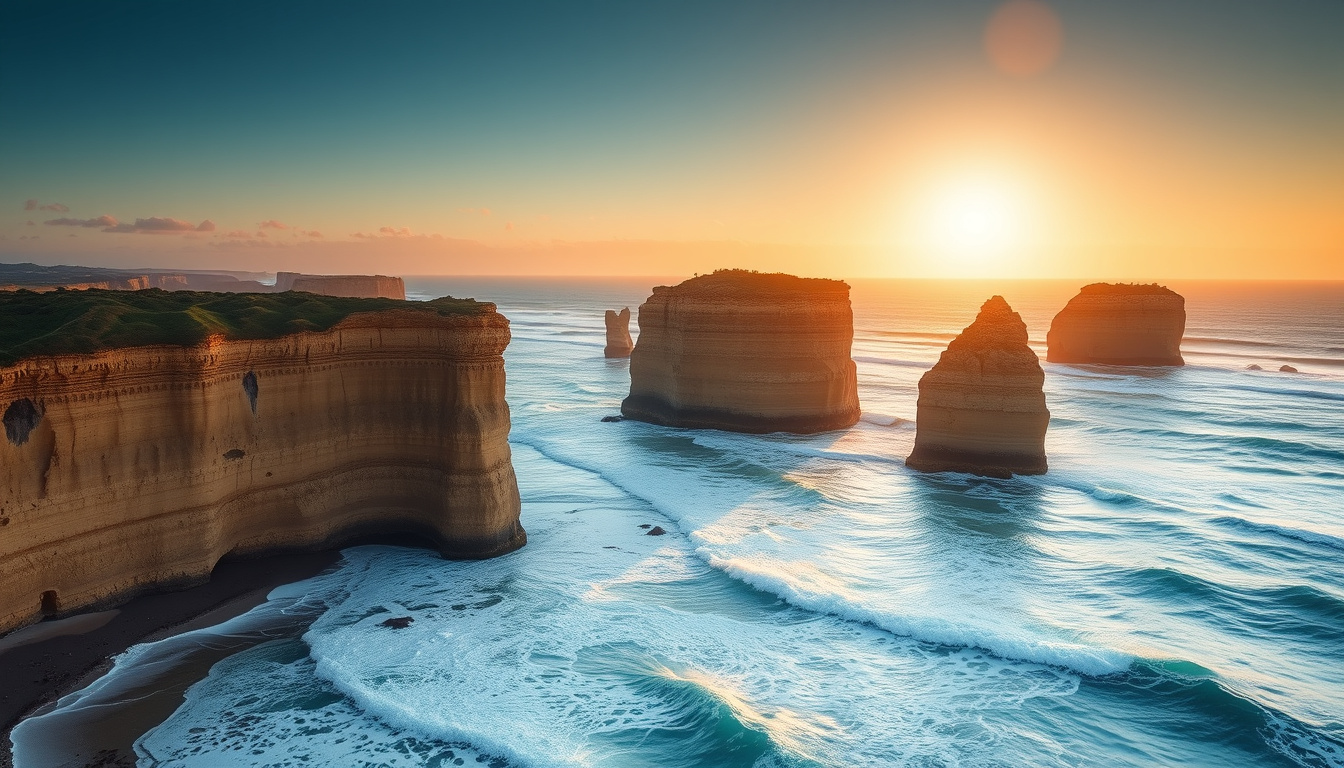

Most visitors search for “12 Apostles Melbourne” expecting a quick city-side detour—but these limestone stacks actually sit 275 kilometres southwest, off Victoria’s Shipwreck Coast. The name confuses people too: despite the Melbourne label, the formations are part of Port Campbell National Park, not the city itself. This guide cuts through the geography confusion and gives you the facts you need for a smooth visit.
Distance from Melbourne: 275 km · Drive time: 4–4.5 hours · Remaining stacks: 7 · Location: Port Campbell National Park · Route: Great Ocean Road
Quick snapshot
- 275 km from Melbourne via Great Ocean Road (Visit Great Ocean Road)
- 7 limestone stacks currently standing (Tourism Australia)
- Admission is free, open 365 days from dawn to dusk (Visit Great Ocean Road)
- Exact timeline for future stack collapses remains unpredictable
- No public transport runs directly to the site year-round
- Last major collapse occurred in 2005, reducing count from 9 to 8 (Tourism Australia)
- Ongoing erosion continues to reshape the formations (Tourism Australia)
- Visitor Centre open 10:00–17:00 daily (Visit Great Ocean Road)
- 600 m of accessible boardwalks now open (Visit Great Ocean Road)
The table below consolidates the essential travel facts for planning your trip to the 12 Apostles.
| Fact | Detail |
|---|---|
| Distance from Melbourne | 275 km |
| Drive Time | 4 hours via Great Ocean Road |
| Stacks Remaining | 7 |
| National Park | Port Campbell |
| Formed Over | 20 million years |
| Stack Height | 45 metres |
| Admission Fee | Free |
| Closest Town | Princetown (6 km) |
How far is Melbourne from the 12 Apostles?
The 12 Apostles lie 275 kilometres southwest of Melbourne along the Great Ocean Road, according to the official Visit Great Ocean Road tourism body. The scenic coastal route takes roughly 4 to 4.5 hours of driving time, depending on traffic and how many viewpoints you stop at along the way.
Driving routes
Two main routes connect Melbourne to the 12 Apostles. The coastal Great Ocean Road route is the scenic choice, winding through seaside towns like Torquay, Apollo Bay, and Lorne. A round-trip tour along this route covers over 500 kilometres, making it a substantial commitment for a day visit, as noted by Great Ocean Road Melbourne Tours.
The inland Princes Highway route shaves roughly 45 minutes off the journey, cutting the drive to about 3 hours, per A Passion and a Passport. The trade-off is missing the ocean vistas and coastal attractions that make the Great Ocean Road famous.
The fastest recorded driving time, according to Rome2Rio, is 2 hours 58 minutes via the inland route—but that assumes minimal stops and no traffic delays.
The inland route saves 45 minutes but skips every coastal attraction between Geelong and the 12 Apostles. Tour operators warn that travellers taking the shortcut “will end up missing some of the best attractions on offer along” the scenic route, per Great Ocean Road Melbourne Tours.
Alternative transport
No direct public bus or train reaches the 12 Apostles. Most visitors either drive themselves, join a guided tour from Melbourne, or fly into the region and rent a car. Tour operators offering day trips include Great Ocean Road Melbourne Tours and various platforms like GetYourGuide.
The 12 Apostles sit within Port Campbell National Park, which stretches 30 kilometres along the coast between Princetown and Peterborough, according to Visit Great Ocean Road.
How to visit 12 Apostles from Melbourne?
Reaching the 12 Apostles from Melbourne requires either a full-day commitment by car or booking onto a guided tour. The site itself is free to enter, with lookouts and walking trails open 365 days a year from dawn to dusk, per Visit Great Ocean Road.
Day trip options
A day trip from Melbourne to the 12 Apostles is feasible but tiring. Most visitors depart between 6:00 and 7:00 AM to arrive at the site by mid-morning. The Visitor Centre kiosk opens at 10:00 AM and closes at 5:00 PM daily, as noted by Visit Great Ocean Road.
Morning arrivals catch the formations in softer light for photography. Afternoon visits often mean crowded viewing platforms during peak season (December through February).
Overnight stays
Splitting the journey with an overnight stop in Apollo Bay, Lorne, or Port Campbell makes the trip much more comfortable. Port Campbell, the closest town with full amenities, sits just 12 kilometres west of the 12 Apostles site, per Visit Great Ocean Road.
Princetown, 6 kilometres west of the formations, is technically closer but has fewer accommodation options. The small town does serve as the trailhead for the Great Ocean Walk, a 104-kilometre coastal track that ends at the 12 Apostles.
Tour bookings
Guided tours typically include transport, a structured itinerary, and commentary on the region’s geology and history. Full-day tours depart Melbourne in the early morning and return late evening. Multi-day tours allow exploration of the Great Ocean Road at a slower pace.
Booking a tour removes the navigation burden from an unfamiliar 500-kilometre round trip, but self-drive visitors can customise stops at locations like the Gibson Steps, where 86 stairs lead down to a beach framed by 70-metre limestone cliffs, per Tourism Australia.
How many of the 12 Apostles are left in Victoria?
Seven limestone stacks currently stand along the Port Campbell coast, not twelve. The formations were never a set of exactly twelve—they were named loosely after the biblical Twelve Apostles, and the number has always fluctuated as erosion claims older stacks and leaves newer ones exposed.
Current count
The most recent major collapse happened in 2005, when a 50-metre stack fell into the Southern Ocean, reducing the visible count from nine to eight. One more stack has since collapsed, leaving seven standing today, as documented by Tourism Australia.
The existing stacks reach approximately 45 metres in height, roughly equivalent to a 12-storey building, according to Tourism Australia.
Erosion history
The formations were carved from limestone over 20 million years as the Southern Ocean battered the Port Campbell coastline. Constant wave action, wind, and rain continue to hollow and weaken the remaining stacks, making each visit potentially unique.
Geologists cannot predict exactly when the next collapse will occur. The formations that survive today are simply those that have so far resisted the relentless erosion that has already claimed their predecessors.
The implication: visitors who want to see all seven remaining stacks should not delay indefinitely—the formations are genuinely diminishing with each passing year.
Why is it called 12 Apostles in Melbourne?
The name “12 Apostles” is a marketing creation, not a geographical description. The formations were colloquially dubbed the “Sow and Piglets” by early settlers before tourism operators rebranded them in the 20th century, according to historical accounts documented by Wikipedia.
Name origin
The “12 Apostles” label stuck despite the formation count never reaching twelve. At most, nine stacks were visible simultaneously. The name gained popularity through tourism promotion and has since become the standard identifier in travel literature and mapping applications.
Despite the frequent “Melbourne” qualifier in search queries, the formations are not located in or near Melbourne. They belong to Port Campbell National Park, approximately 4.5 hours’ drive southwest of the city along Victoria’s Shipwreck Coast.
Location clarification
The closest town to the 12 Apostles is Princetown, situated 6 kilometres west of the viewing platforms, per Visit Great Ocean Road. Port Campbell lies 12 kilometres further west and serves as the main hub for accommodation, dining, and visitor services in the area.
The confusion likely stems from Melbourne being the primary international airport for Victoria and the base for most Great Ocean Road tours. Visitors searching “12 Apostles Melbourne” are typically looking for practical travel information from that city as their starting point.
The pattern: tourism marketing often outlasts geographic accuracy, and the “12 Apostles” brand has proven sticky enough to persist even though the original name never matched reality.
What town is closest to the 12 Apostles?
Princetown is the closest settlement to the 12 Apostles, sitting just 6 kilometres west along the Great Ocean Road, according to Visit Great Ocean Road. The small town has a basic convenience store, a pub, and the Princetown Nature Tales & Gallery.
Princetown
Princetown serves primarily as a trailhead for the Great Ocean Walk. The 7-kilometre boardwalk section from Princetown to the 12 Apostles follows a moderate path through coastal scrubland, offering views before the formations come into sight, per Tourism Australia.
Accommodation in Princetown is limited. The Princetown Guest House and several holiday rentals represent the main options, but availability drops significantly during school holidays and summer weekends.
Accommodation nearby
Port Campbell, 12 kilometres west of the formations, offers the widest range of accommodation including motels, holiday apartments, caravan parks, and boutique stays. The town has roughly 20 accommodation providers catering to various budgets.
Alternative base towns along the Great Ocean Road include Apollo Bay (roughly halfway from Melbourne) and Lorne (about two-thirds of the way). These towns offer more facilities but require additional driving to reach the 12 Apostles.
For visitors prioritising proximity to the 12 Apostles at sunrise or sunset, Port Campbell makes the most practical base. The town offers more accommodation choices, restaurants, and fuel stations than smaller Princetown, while still keeping the formations a short drive away.
The catch: Port Campbell’s popularity means accommodation books out quickly during peak season, so visitors should reserve several weeks ahead for summer visits.
Visitor information
Accessibility features at the 12 Apostles have improved significantly in recent years. The site now includes 600 metres of sealed paths and accessible boardwalks, as noted by Visit Great Ocean Road. A 300-metre path connects the car park to the Visitor Centre and main viewing platforms.
Wheelchair-accessible toilets at the Visitor Centre are open 24 hours, and wheelchairs are available upon request from kiosk staff between 10:00 AM and 5:00 PM, per Visit Great Ocean Road.
Parking at the 12 Apostles is free. During peak season, the car park fills by mid-morning on fine weekends, forcing vehicles to queue on the Great Ocean Road approach.
“If you take the inland route, you will end up missing some of the best attractions on offer along” the Great Ocean Road, according to Great Ocean Road Melbourne Tours, a Melbourne-based tour operator.
A round trip tour from Melbourne to the 12 Apostles travelling along the Great Ocean Road will take your travel distance up over 500 kilometres, noted Great Ocean Road Melbourne Tours, a Melbourne-based tour operator.
Related reading: Melbourne BOM Radar Guide · Melbourne Cup Horses 2025
tripadvisor.com, greatoceanroadauthority.vic.gov.au, getyourguide.com, visitgreatoceanroad.org.au
Frequently asked questions
What happened to the 12 Apostles in Melbourne?
Nothing happened “in Melbourne”—the 12 Apostles never existed in Melbourne. The formations are located in Port Campbell National Park, 275 kilometres southwest of Melbourne. The name persists in search queries because Melbourne serves as the departure point for most visitors.
How many of the 12 Apostles are left?
Seven limestone stacks currently stand. The last major collapse occurred in 2005, and at least one additional stack has fallen since. The formations continue to erode, and the count will eventually decrease further.
What town is closest to the 12 Apostles?
Princetown is 6 kilometres west of the formations. Port Campbell, 12 kilometres further west, offers more accommodation and services. Both towns serve as bases for visiting the site.
How far is Melbourne from the 12 Apostles?
The 12 Apostles are 275 kilometres from Melbourne via the Great Ocean Road. The drive takes 4 to 4.5 hours one way. An inland route via the Princes Highway takes approximately 3 hours but skips the scenic coastal attractions.
What is the best time to visit the 12 Apostles?
Early morning or late afternoon offers the best light for photography and fewer crowds. Summer weekends (December through February) are busiest. The site is open 365 days a year from dawn to dusk, free of charge.
Is the 12 Apostles Visitor Centre open every day?
The Visitor Centre kiosk opens from 10:00 AM to 5:00 PM daily. The viewing platforms and walking trails remain accessible from dawn to dusk regardless of kiosk hours.
Can I walk from Princetown to the 12 Apostles?
Yes. A 7-kilometre moderate boardwalk track connects Princetown to the 12 Apostles. The walk takes approximately 1.5 to 2 hours and follows the established Great Ocean Walk route through coastal terrain.

Victoria Hayes is Editor-in-Chief at Aussie Brief, overseeing editorial standards, publication decisions and corrections.