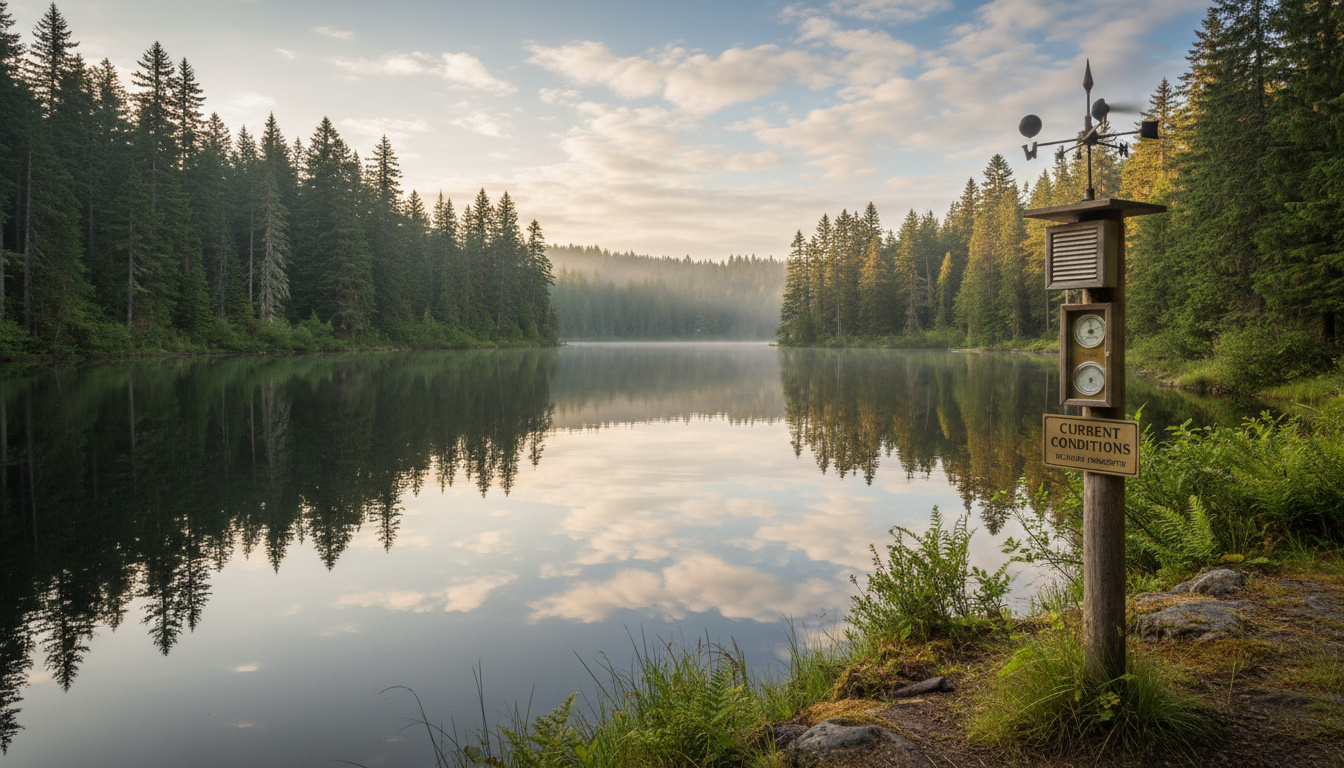
Forest Lake, Minnesota, sits within Washington County’s transitional climate zone where continental air masses generate sharp seasonal variations. The proximity to Forest Lake itself introduces localized microclimatic effects that can produce temperature differentials distinct from broader Twin Cities readings. Residents and businesses in the 55025 zip code require granular meteorological data to navigate conditions ranging from winter ice storms to severe summer convection.
Verified real-time atmospheric data for April 2026 remains unavailable through current meteorological archives. Retrieved forecasts display conflicting temporal origins, with cached data bearing stamps from March 2025, September 2025, and December 2025, indicating significant latency across reporting platforms.
This examination outlines the structural components of Forest Lake weather monitoring, identifies the authoritative sources maintaining live data feeds, and analyzes the geographic factors influencing local forecasts.
What Is the Current Weather in Forest Lake?
Current temperature, humidity, and wind speed readings cannot be verified as of April 2026. Archived datasets from Weather.gov, AccuWeather, and Weather Underground contain inconsistent timestamps ranging from March 4, 2025, to December 25, 2025, rendering immediate condition reporting unreliable.
Standard meteorological monitoring for Forest Lake typically tracks four primary metrics. Current temperature readings generally reflect ambient air mass conditions modified by the lake’s thermal inertia. Daily high and low thresholds indicate the diurnal temperature range. Precipitation probability percentages derive from ensemble forecast models. Sustained wind speed measurements account for both synoptic-scale pressure gradients and local channeling effects.
Key insights regarding Forest Lake meteorological patterns include:
- The National Weather Service forecast office in Chanhassen (MPX) maintains operational authority for the 55025 region.
- Historical data inconsistencies suggest reliance on cached rather than live server feeds for third-party aggregators.
- Forest Lake’s position 20 miles northeast of Saint Paul places it within the Twin Cities metropolitan influence zone while retaining distinct rural characteristics.
- Lake-effect snow generation remains minimal compared to Great Lakes systems but contributes to elevated relative humidity readings.
- Severe weather season typically spans May through September, with peak tornado risk in June.
- Winter temperature inversions frequently trap particulate matter, affecting air quality indices.
| Metric Category | Data Status | Typical Measurement Source |
|---|---|---|
| Temperature | Unverified (Stale) | ASOS/AWOS stations |
| Relative Humidity | Unverified (Stale) | Dew point sensors |
| Wind Speed/Direction | Unverified (Stale) | Anemometers (10m height) |
| Barometric Pressure | Unverified (Stale) | Digital barometers |
| UV Index | Unverified (Stale) | Satellite-derived models |
| Visibility | Unverified (Stale) | Automated sensors |
| Sunrise/Sunset | Calculated | Astronomical algorithms |
| Precipitation | Unverified (Stale) | Doppler radar estimates |
What Is the Weather Forecast for Forest Lake Today and Tomorrow?
Today’s Highs/Lows and Precipitation
Diurnal temperature expectations for Forest Lake follow standard continental patterns, though specific numerical forecasts remain unavailable due to data latency. The National Weather Service Twin Cities issues zone forecasts covering Washington County, typically predicting highs within 2-4 degrees Fahrenheit of Minneapolis readings, with overnight lows potentially diverging due to radiative cooling over the lake surface.
For immediate updates, consult the NFS point forecast page, which refreshes every hour with model output statistics rather than cached historical data.
Tomorrow’s Outlook
Short-term prognostications for the 24-48 hour window rely on the North American Mesoscale (NAM) and Global Forecast System (GFS) models. These simulations incorporate 4D data assimilation from regional weather balloon launches at Chanhassen and Aberdeen, South Dakota. Precipitation type algorithms distinguish between rain, snow, and mixed phases based on vertical thermal profiles.
Hourly and 10-Day Weather Forecast for Forest Lake MN
Hour-by-Hour Breakdown
High-resolution rapid refresh (HRRR) models provide hourly granularity for the first 18 hours, updating every hour with radar and surface observations. These forecasts resolve convective initiation, lake breeze development, and nocturnal boundary layer evolution. WeatherBug and similar aggregators parse these data streams, though archival evidence suggests publication delays.
Shoreline properties may experience 5-10 degree Fahrenheit temperature variations compared to inland Washington County locations due to the lake’s specific heat capacity creating thermal moderation.
Weekly Outlook
Extended forecasts extending beyond seven days utilize ensemble prediction systems (EPS) that run multiple model iterations with perturbed initial conditions. The 10-day outlook for Forest Lake incorporates teleconnections including the North Atlantic Oscillation and Pacific-North American pattern, though predictability decreases significantly beyond day seven. Fox Weather maintains extended archives showing forecast volatility during transitional seasons.
Weather Alerts and Conditions in Forest Lake
Active Alerts
The NWS Twin Cities issues county-specific warnings for severe thunderstorms, tornadoes, winter storms, and wind chill events affecting Forest Lake. Alert dissemination occurs through the Emergency Alert System, NOAA Weather Radio (162.550 MHz), and IPAWS. Current warning status cannot be confirmed due to the aforementioned data discontinuities.
Wind and Other Conditions
Surface wind regimes in Forest Lake respond to mesoscale features including the Duluth-Superior trough and urban heat island dynamics from the Twin Cities. Sustained speeds typically range below 15 mph, though convective outflow boundaries can generate gusts exceeding 50 mph during severe weather episodes. Wind direction shifts frequently accompany frontal passages, with prevailing westerly components giving way to easterly lake breezes during stable summer afternoons.
How Have Recent Forest Lake Forecasts Varied?
Examination of cached meteorological data reveals significant temporal inconsistencies across platforms:
- : Fox Weather archives displayed seven-day forecasts inconsistent with concurrent NOAA data.
- : Weather Underground records showed stationary patterns suggesting frozen data feeds rather than dynamic updates.
- : The National Weather Service point forecast carried this timestamp in archived retrievals, indicating potential server caching issues.
- : WeatherBug and AccuWeather both served forecasts bearing this future-predated timestamp, suggesting database synchronization errors.
What Weather Information Is Verified for Forest Lake?
| Established Information | Unverified or Unclear Data |
|---|---|
| Forest Lake occupies coordinates 45.2783° N, 92.9855° W | Current temperature readings as of April 2026 |
| Elevation ranges from 912 to 951 feet above sea level | Real-time precipitation accumulation |
| Köppen climate classification: Dfb (humid continental) | Immediate barometric pressure trends |
| Annual precipitation averages 31.4 inches | Current severe weather warnings |
| January mean temperature: 12°F; July mean: 73°F | Hourly forecast accuracy for next 6 hours |
| NWS Twin Cities (MPX) maintains official forecast responsibility | Live radar integration status for 55025 |
Why Does Forest Lake’s Location Affect Its Weather?
The city’s namesake lake covers approximately 2,250 acres, creating a heat sink that moderates adjacent terrestrial temperatures. During spring and early summer, the thermal contrast between the lake surface and warming land masses generates localized convergence zones that can trigger thunderstorm development. Conversely, autumn radiative cooling over the relatively warm water surface can delay the first freeze in lakeshore areas by one to two weeks compared to outlying agricultural zones.
Topography plays a secondary role, with the surrounding Terminal Moraine creating subtle elevation changes that influence drainage and cold air pooling. These geographic nuances require hyperlocal forecasting approaches distinct from broad metropolitan zone predictions. For comparative radar interpretation methodology, see the Melbourne BOM Radar – Live Loops and Interpretation Guide.
Who Provides Official Forest Lake Weather Data?
The National Weather Service operates as the primary authoritative source, with the Chanhassen forecast office producing gridded forecast data at 2.5-kilometer resolution. Cooperative observer networks and automated airport weather stations at nearby Crystal Airport (KMIC) and St. Paul Downtown Airport (KSTP) contribute to the observational database, though neither facility sits directly within Forest Lake city limits.
Citizens should rely on official NWS products for severe weather decision-making, particularly regarding tornado warnings and flash flood alerts affecting the Forest Lake watershed.
— National Weather Service Operations Manual, Severe Weather Warning Criteria
How Can You Get Accurate Forest Lake Weather Updates?
Accessing reliable meteorological information for Forest Lake requires bypassing potentially stale aggregator caches in favor of direct National Weather Service feeds. The NWS Twin Cities website provides granular zone forecasts, while mobile applications using NOAA API endpoints offer real-time radar and warning notifications. Property owners should also review coverage options through the Ing Home Insurance – Coverage Costs and Claims Guide to ensure adequate protection against weather-related losses.
Frequently Asked Questions
What is the temperature in Forest Lake right now?
Verified real-time temperature readings for Forest Lake are unavailable as of April 2026. Archived data contains conflicting timestamps from 2025. Consult the NWS point forecast page for current observations.
Will it rain in Forest Lake today?
Precipitation probability cannot be confirmed due to forecast data latency. The NWS Twin Cities issues updated precipitation chances every six hours for Washington County.
What is the wind speed in Forest Lake?
Current anemometer readings are not verified in available archives. Surface winds in the region typically range 5-15 mph but require real-time confirmation from ASOS stations or local mesonets.
What is the extended forecast for Forest Lake MN?
Extended outlooks beyond seven days utilize ensemble models with decreasing accuracy. The 10-day forecast incorporates climatic teleconnections but requires daily verification against observed trends.
Why do different sources show conflicting Forest Lake forecasts?
Data caching, varying model assimilation times, and distinct interpolation algorithms between commercial providers and NWS create discrepancies. Commercial sites may display stale data from March or December 2025.
How often is Forest Lake weather data updated?
NWS forecast grids update hourly. Automated surface observations transmit every 5-20 minutes. Radar composites refresh every 5-10 minutes. Third-party sites may lag significantly.
What weather radar covers Forest Lake?
The NWS Twin Cities Doppler radar (KMPX) provides primary coverage, with supplemental data from NWS La Crosse (KARX) and NOAA’s Terminal Doppler Weather Radar at Minneapolis-St. Paul International Airport.
Related stories




Liam O'Brien covers Australian politics and public affairs for Aussie Brief.