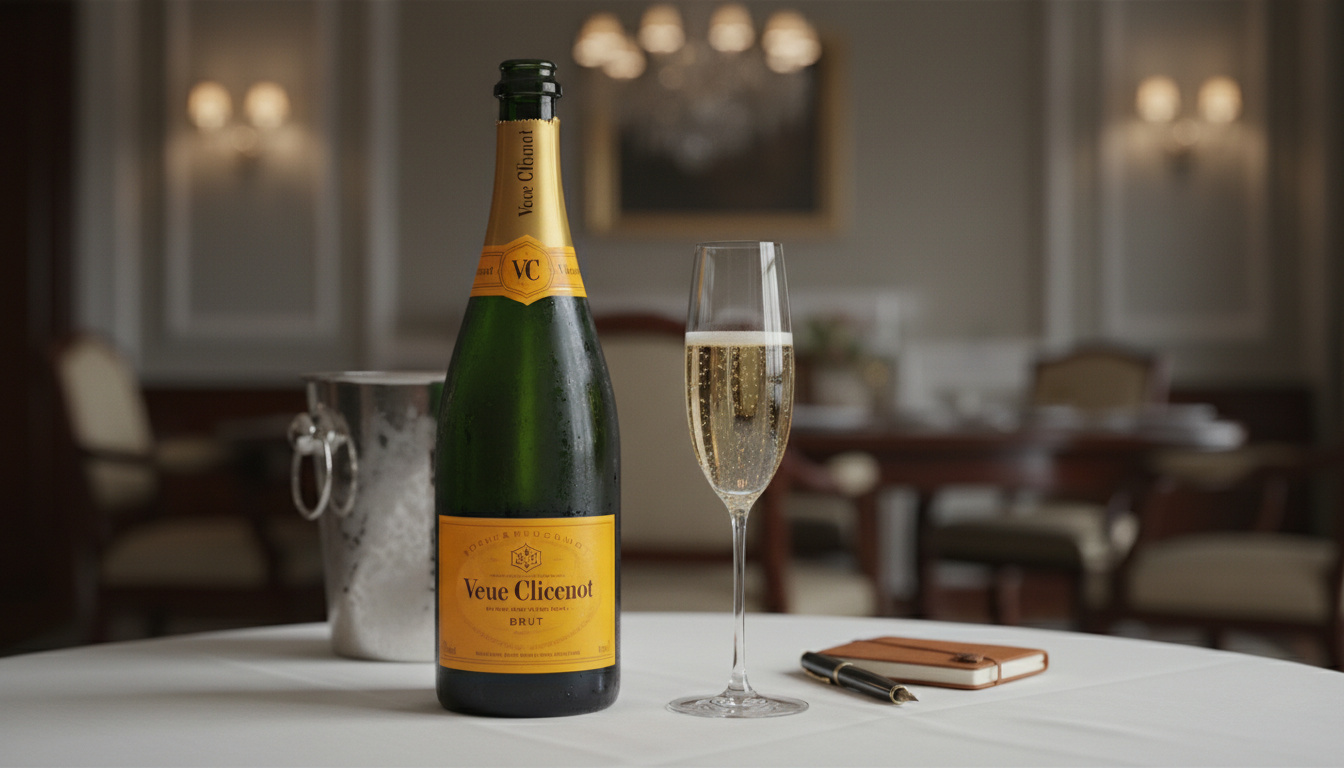
Veuve Clicquot Yellow Label Brut stands as one of Champagne’s most recognizable non-vintage cuvées, commanding shelf space from luxury resorts to neighborhood wine shops. The iconic yellow label signals a specific house style built upon Pinot Noir dominance, offering a structured yet approachable profile that has defined celebratory moments since the 19th century.
Established in 1772, this Reims-based maison pioneered innovations like riddling and sabrage while maintaining consistency through multi-vintage blending. With professional scores consistently hovering in the low to mid-90s and retail prices typically settling between $50 and $70, the wine balances accessibility with the complexity expected of heritage Champagne houses.
Consumer feedback highlights the cuvée’s smooth, refreshing fruitiness and premium presentation, positioning it as both an aperitif option and a meal companion for those seeking dry, food-friendly bubbles.
What Is Veuve Clicquot Brut?
At its core, Veuve Clicquot Yellow Label represents the house’s signature non-vintage expression, blending multiple harvests to achieve consistency across releases. The composition emphasizes power and structure through a grape majority of Pinot Noir, supported by Chardonnay’s elegance and Pinot Meunier’s fruitiness.
- Pinot Dominance: The 55% Pinot Noir majority provides structural backbone and vinous depth uncommon in entry-level Champagnes.
- Aging Protocol: Minimum three years on lees develops signature toasty brioche and pastry notes.
- Critical Consensus: Consistent 90+ point scores including 93 Tasting Panel, 92 James Suckling, and 92 Wine Spectator.
- Market Position: Retail positioning between $50–$70 places it in the premium accessible luxury tier.
- Format Stability: Non-vintage blending ensures house style consistency regardless of single-year weather variations.
- Visual Identity: The distinctive yellow label, introduced in 1877, remains one of wine’s most recognizable packaging elements.
- Alcohol Integration: Approximately 12% ABV aligns with standard Brut Champagne norms, supporting food pairing versatility.
| Attribute | Specification |
|---|---|
| Grape Blend | 55% Pinot Noir, 30% Chardonnay, 15% Pinot Meunier |
| Dosage | 8–10g/L (estimated) |
| Aging | Minimum 3 years on lees |
| Bottle Size | 750ml (standard) |
| ABV | ~12% |
| Price Range | $50–$70 USD |
| Serving Temperature | 8–10°C (46–50°F) |
| Closure | Cork and cage |
| First Released | 1877 (Yellow Label era) |
| House Founded | 1772 |
Tasting Notes and Flavor Profile of Veuve Clicquot Brut
Aroma and Visual Presentation
The wine pours a golden-yellow hue with fine, persistent bubbles forming a delicate foaming necklace. The aromatic profile opens with yellow and white stone fruits—pear, apple, and peach—layered with citrus elements including grapefruit, lemon, orange peel, and lime. Secondary fermentation characters emerge as vanilla, brioche, and toast, while subtle tertiary notes of quince, almonds, licorice, and smoke add complexity.
Palate Structure and Finish
On the palate, the medium-bodied texture delivers creamy mouthfeel balanced by fine tannins and high acidity. Flavor progression moves from initial pear and lemon through red fruits and blueberries into baked apple and pastry notes. A mineral streak runs through the mid-palate, finishing with honeysuckle and nutty, vinous persistence.
Critics consistently note the wine’s firm acidity and structural backbone derived from its Pinot Noir majority, distinguishing it from lighter, Chardonnay-forward alternatives. Professional reviews emphasize this structural integrity as key to its aging potential.
Critical Reception
Recent professional evaluations reflect consistent quality across batches. Tasting Panel awarded 93 points, highlighting baked apple, quince, salted almond, white blossom, red berry, and pastry notes with particular emphasis on firm acidity. James Suckling scored it 92, noting grapefruit, citrus peel, quince, toast, and almonds with a silky, nutty end.
Wine Spectator’s 92-point review identified mandarin orange, blackberry, toast, and pastry cream, praising lively acidity and smoky finish. Decanter contributed 91 points for red fruits, blueberries, and quince, describing the wine as fruit-intense and demanding. Wine Enthusiast characterized the profile as crisp apple with a drier edge.
Veuve Clicquot Brut Price and Where to Buy
Current Market Positioning
The 750ml standard bottle typically retails between $50 and $70, though exact pricing varies by market, retailer, and local taxation. Specialty merchants occasionally offer vintage-specific pricing fluctuations, but the non-vintage format generally maintains stable entry-level luxury positioning.
Storage and Authenticity Considerations
For optimal preservation, store bottles at cellar temperature around 55°F/13°C away from light and vibration. When purchasing, authorized retailers provide authenticity guarantees crucial for this heavily counterfeited brand. Recent NV releases offer the freshest expression for immediate consumption.
Retail prices fluctuate significantly based on regional import duties and state taxation. Metropolitan markets often show lower per-bottle pricing than remote or resort destinations.
How to Serve and Pair Veuve Clicquot Brut
Temperature Protocols
Serving temperature critically affects aromatic expression. Chill to 8–10°C (46–50°F) to emphasize crisp fruit and minerality. Allowing the bottle to warm slightly to 12–13°C (55°F) enhances complexity and broadens the aromatic range for contemplative tasting.
Over-chilling below 8°C masks the wine’s complexity and aromatics. Ice buckets should contain water and ice rather than ice alone to prevent excessive chilling.
Culinary Applications
The wine’s structure and acidity support diverse food pairings. Seafood and poultry provide classic matches, while the ripe peach, lemon zest, and green apple notes complement light, delicate dishes without overwhelming them.
Cocktail Integration
Mixologists utilize Yellow Label in classic Champagne cocktails. The French 75 combines 30ml Yellow Label with 30ml gin, 15ml lemon juice, and 10ml simple syrup. For simpler service, an Aperitif Spritz mixing the Champagne with soda and a lemon twist highlights the base wine’s fruit and effervescence.
The Historical Evolution of Veuve Clicquot Brut
- : Philippe Clicquot founds the Champagne house in Reims, establishing one of France’s oldest continuing marques.
- : Barbe-Nicole Clicquot assumes control following her husband’s death, becoming the “Veuve” (Widow) who would revolutionize Champagne production.
- : Development of the riddling (remuage) technique enables clearer wine without waste, fundamentally changing Champagne clarity standards.
- : First recorded shipment to Russia establishes international market presence.
- : Introduction of the distinctive yellow label distinguishes bottles from competitors’ clear or green glass, creating an enduring visual trademark.
- : Consistent 90+ point scores from major publications solidify market position as a benchmark non-vintage Brut.
Established Facts and Remaining Questions
| Established Information | Information Remaining Unclear |
|---|---|
| Non-vintage blend varies yearly for consistency | Exact percentages of reserve wines in each release |
| Minimum 3 years aging on lees | Specific vintage composition of current market releases |
| Dominant Pinot Noir character (55%) | Proprietary fermentation techniques beyond standard Champagne method |
| 12% ABV standard | Exact dosage levels per batch (estimated 8-10g/L) |
| Yellow label introduced 1877 | Future vintage release schedules for house prestige cuvées |
Market Position and Brand Distinction
Within the luxury Champagne landscape, Veuve Clicquot occupies a distinct niche between mass-market entry Champagnes and ultra-prestige tête de cuvée offerings. Its Pinot-dominant structure provides more power and silkiness compared to Chardonnay-forward competitors like Moët & Chandon Brut Impérial, which typically presents brighter, more immediately accessible fruit profiles.
The brand’s popularity stems from this consistent stylistic signature combined with the iconic visual branding that transfers easily from retail environments to social occasions. Unlike vintage-specific bottlings that fluctuate with agricultural conditions, Yellow Label’s multi-vintage approach ensures reliable expression suitable for both immediate consumption and short-term cellaring. While the Yellow Label’s consistent expression is a key selling point, for a different kind of immersive experience, consider the Bose QuietComfort Ultra headphones review at $Bose QuietComfort Ultra headphones.
Critical Reception and Expert Analysis
Baked apple, quince, salted almond, white blossom, red berry, pastry; firm acidity.
— Tasting Panel, 93 Points
Grapefruit, citrus peel, quince, toast, almonds; silky, nutty end.
— James Suckling, 92 Points
Mandarin orange, blackberry, toast, pastry cream; lively acidity, smoky finish.
— Wine Spectator, 92 Points
Key Takeaways on Veuve Clicquot Brut
Veuve Clicquot Yellow Label Brut delivers a Pinot Noir-driven Champagne experience marked by structural integrity, consistent quality, and food-friendly acidity. Positioned between accessibility and luxury, it suits celebrations, meals, and cocktail applications while maintaining the house’s 250-year heritage of innovation. For travelers planning celebrations abroad, securing bottles through reputable retailers remains essential, much like arranging reliable transportation such as Perth to Bali Flights requires verified booking channels to ensure arrival quality.
Frequently Asked Questions
Is Veuve Clicquot Brut sweet or dry?
The wine is definitively dry (Brut), containing approximately 8–10g/L dosage. Professional reviewers describe it as crisp with a drier profile, though fruit flavors may suggest sweetness to some palates.
What grapes make up Veuve Clicquot Brut?
The blend comprises 55% Pinot Noir, 30% Chardonnay, and 15% Pinot Meunier. This Pinot-heavy composition creates the wine’s characteristic structure and vinous depth.
Is Yellow Label a vintage Champagne?
No, Yellow Label is primarily non-vintage, blending multiple years for consistency. The house produces separate vintage-dated Champagnes in strong years like 2012, 2013, and 2015.
How long can I store an unopened bottle?
Non-vintage bottles remain optimal for 3–5 years from purchase when stored properly at 55°F/13°C. The wine is released ready to drink and does not require extended aging.
What is sabrage and is it safe with this bottle?
Sabrage involves opening the bottle with a saber along the seam using internal pressure. It is safer with stronger non-vintage bottles like Yellow Label, though requires proper chilling and technique.
How does it compare to Dom Pérignon?
Yellow Label is non-vintage and entry-level luxury, while Dom Pérignon is vintage-only prestige cuvée. Veuve offers immediate structure and power; Dom Pérignon provides complexity and aging potential at significantly higher prices.
Can I use it for cocktails?
Yes, it works well in classics like the French 75 or Champagne Spritz. However, its price point may encourage using less expensive sparkling wine for mixed drinks.

Grace Clarke leads fact-checking, source verification and corrections at Aussie Brief.