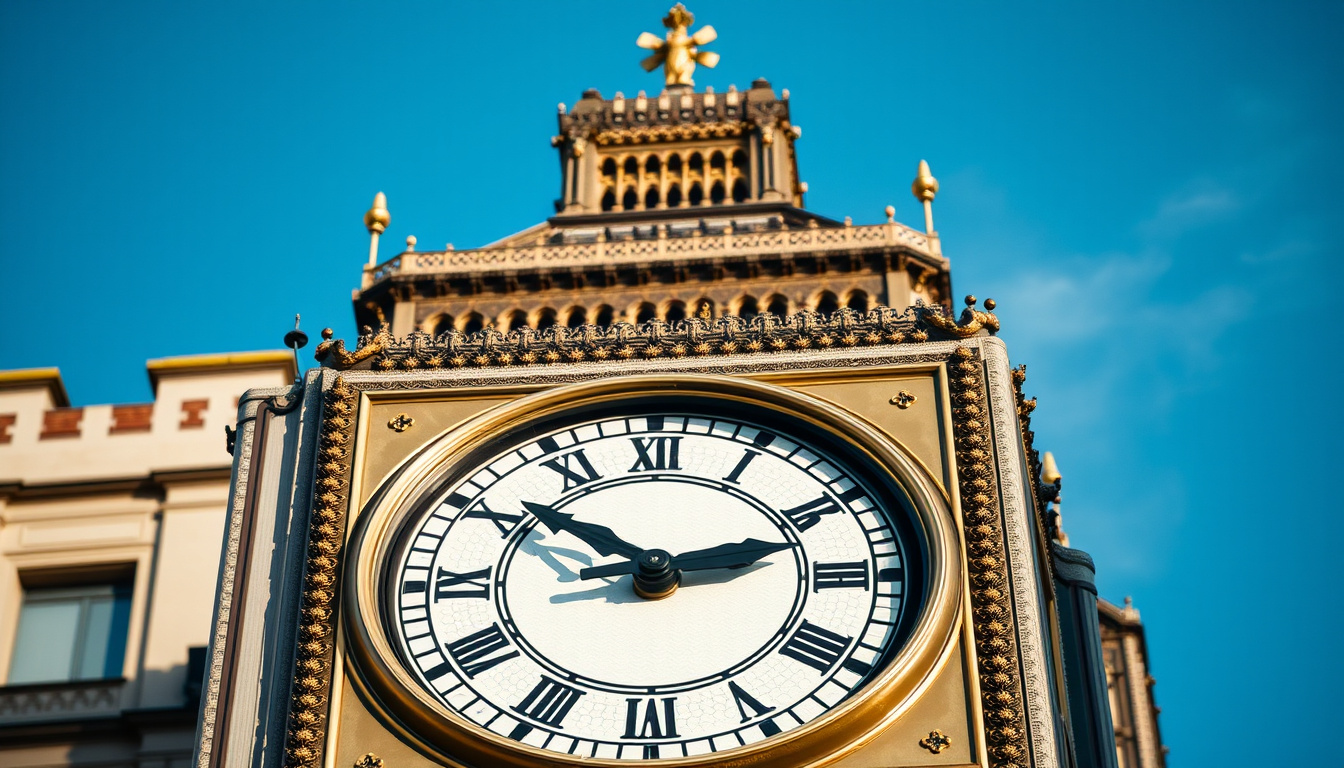
There’s a moment every autumn when 1:59 AM strikes twice, signalling the end of British Summer Time and the return to Greenwich Mean Time, the UK’s winter clock. The UK government has confirmed that in 2026 clocks go back at 2am on Sunday, 25 October GOV.UK (UK government official portal).
Current local time: Varies by date (e.g., 14:30 BST or GMT) ·
Winter time zone (October–March): Greenwich Mean Time (GMT, UTC+0) ·
Summer time zone (March–October): British Summer Time (BST, UTC+1) ·
Next fall back: ·
Time difference with Ireland: 0 hours
Quick snapshot
- Check the live time at time.is or timeanddate.com
- UK uses GMT (UTC+0) in winter and BST (UTC+1) in summer (GOV.UK)
- Current session depends on the date
- Spring forward: last Sunday March at 1am GMT → 2am BST
- Fall back: last Sunday October at 2am BST → 1am GMT (GOV.UK)
- Next fall back:
- Both countries use the same DST schedule
- No time difference at any time of year (Wikipedia)
- Ireland uses Irish Standard Time (UTC+1) in summer and GMT in winter
- Yes – when clocks go back you gain one hour
- The hour from 1am to 2am BST is repeated as 1am to 2am GMT (RAC Drive)
- Only happens during the autumn clock change
Here is a summary of the essential time zone facts.
| Current UK time zone | BST (British Summer Time) or GMT depending on date |
| UTC offset winter | UTC+0 (GMT) |
| UTC offset summer | UTC+1 (BST) |
| Next clock change | (fall back) if article published after March 2026 |
| Country observing DST | Yes, since 1916 |
| Time difference with Ireland | 0 hours |
What time is it in the UK just now?
The answer depends on the calendar. From late March to late October, the UK is on British Summer Time (BST), which is one hour ahead of Greenwich Mean Time (GMT). For the rest of the year, the country reverts to GMT. To see the exact seconds, services like time.is (independent time authority) or timeanddate.com (global time reference) provide live clocks synchronised to atomic time.
What does GMT stand for?
GMT stands for Greenwich Mean Time, the mean solar time at the Royal Observatory in Greenwich, London. The Royal Museums Greenwich explain that GMT is the baseline for all time zones worldwide Royal Museums Greenwich (historic time authority). When the UK is not observing daylight saving, its civil time is exactly GMT.
What is the current GMT?
GMT itself does not change — it is always UTC+0. But the UK’s civil time shifts between GMT (winter) and BST (summer). At any moment, the current GMT is the same as the time in Iceland or on the west coast of Africa. You can view the live GMT clock at time.is (time.is/GMT).
Is the UK currently on BST or GMT?
As of , the UK is on BST. Clocks moved forward on at 1am Xoserve (UK gas data authority). They will switch back to GMT on . If you’re reading this between late October and late March, the UK is on GMT.
The implication: knowing the current season avoids confusion for international coordination.
Have clocks gone back in the UK?
Not yet in 2026. The autumn clock change always occurs on the last Sunday of October. In 2026 that falls on . Between and that date, the UK stays on BST (RAC Drive).
When do the clocks change?
- Spring forward: last Sunday of March at 1am GMT → 2am BST
- Fall back: last Sunday of October at 2am BST → 1am GMT
The Royal Museums Greenwich confirm these dates are set by law and have been consistent since the Summer Time Act 1916 (Royal Museums Greenwich).
When do the clocks go back in 2026?
The clocks go back at 2am on , reverting to 1am GMT. This is confirmed by both GOV.UK and Visit London (official visitor guide).
Anyone scheduling international meetings in October 2026 should note that the 2am change affects early-morning calls to Asia or Australia. After the 25th, London is once again 5 hours ahead of New York, not 6.
The catch: the autumn change is fixed but its impact on communication loops is often overlooked.
Is Ireland 1 hour behind the UK?
No — the Republic of Ireland and the UK share the same time year-round. In summer, Ireland uses Irish Standard Time (IST, UTC+1), which is identical to BST. In winter, both countries revert to GMT (UTC+0) (Wikipedia). There is no time difference between Dublin and London at any point in the year.
When do clocks change in Ireland?
Ireland changes its clocks on exactly the same day and time as the UK: the last Sunday of March (forward) and the last Sunday of October (back) (GOV.UK). The two countries synchronize their DST schedules, so cross-border travel is seamless.
What is the time difference between UK and Ireland?
Zero hours. If it’s 10am in London, it’s 10am in Dublin. This constant alignment means that television schedules, flight times, and business hours match perfectly between the two islands.
Some travellers think Ireland is an hour behind because of its westerly longitude. In fact, Ireland’s time zone is exactly the same as the UK’s because both countries adopted DST together in the early 20th century.
The pattern: geographical longitude does not dictate time-zone boundaries in this case.
Why do clocks go back at 2am?
The specific time of 2am was chosen to minimise disruption. Most people were asleep, and the change did not interfere with early church services or newspaper distribution. The BBC Bitesize educational resource notes that 2am also reduced the impact on rail schedules, which at the time were the primary public transport network BBC Bitesize (UK educational resource).
Why do we turn the clocks back?
The purpose of daylight saving time is to make better use of daylight during the longer days of summer. The Summer Time Act 1916 introduced the practice in the UK to save fuel during World War I (Royal Museums Greenwich). Today, the biannual shift continues for similar energy-saving and lifestyle reasons.
Who decided to change clocks at 2am?
The choice of 2am was encoded in the Summer Time Act 1916 and has remained ever since. According to the Royal Museums Greenwich, the decision balanced the needs of railways, the military, and the general public (Royal Museums Greenwich).
While 2am was logical in 1916, modern 24-hour services (healthcare, rail, digital systems) still have to handle the duplicated hour. Emergency services often use UTC internally to avoid confusion.
The implication: historical logic still shapes today’s operations, but adaptation is required.
Do I get an extra hour in bed when the clocks go back?
Yes. When the clocks fall back from 2am BST to 1am GMT, the hour from 1am to 2am is lived twice. The RAC confirms that the UK’s clocks are set back by one hour at 2am on the last Sunday of October (RAC Drive). That means you effectively gain an extra 60 minutes of sleep — or of pre-dawn activity.
What happens to time at 2am when clocks go back?
The clock goes from 01:59 BST directly to 01:00 GMT. The interval between 01:00 and 02:00 BST is then repeated as 01:00 to 02:00 GMT. For anyone awake, digital devices typically update automatically. Manual clocks need to be turned back one hour before bedtime or upon waking.
Does everyone in the UK get an extra hour?
Yes — the change applies to the entire United Kingdom, including England, Scotland, Wales, and Northern Ireland, as well as British Overseas Territories that observe DST. However, territories such as Gibraltar and the Falkland Islands may have different rules.
This comparison shows the identical time zones of the UK and Ireland.
| Attribute | United Kingdom | Republic of Ireland |
|---|---|---|
| Winter time zone | Greenwich Mean Time (GMT, UTC+0) | Greenwich Mean Time (GMT, UTC+0) |
| Summer time zone | British Summer Time (BST, UTC+1) | Irish Standard Time (IST, UTC+1) |
| DST start (2026) | 01:00 GMT → 02:00 | Same day and time |
| DST end (2026) | 02:00 → 01:00 GMT | Same day and time |
| Year-round difference | 0 hours | 0 hours |
The pattern is clear: the UK and Ireland are perfectly synchronised all year. No time conversion is ever needed between London and Dublin.
Timeline signal
- 1916 – Summer Time Act introduces DST in the UK (Royal Museums Greenwich (historic time authority)). For a broader historical context, see The Rest Is History – UK’s Top History Podcast Guide.
- – Clocks spring forward 1 hour (BST starts) (Xoserve (UK gas data authority)).
- – Clocks fall back 1 hour (GMT resumes) (GOV.UK).
The evolution of DST shows a century-old practice still in use.
Confirmed facts
- UK uses GMT in winter and BST in summer (GOV.UK (UK government official portal)).
- Clocks change on the last Sunday of March and October (Royal Museums Greenwich (historic time authority)).
- Ireland and the UK have identical time and DST schedule (Wikipedia (time zone encyclopedia)).
- The 1916 Summer Time Act started DST in the UK (Royal Museums Greenwich (historic time authority)).
What’s unclear
- Future permanent BST or GMT debate – not yet enacted.
- Exact time seconds vary by source – always use a trusted reference.
What is settled: the current cycle is fixed by law.
The clocks go forward by one hour at 1am on the last Sunday in March, and go back by one hour at 2am on the last Sunday in October.
British Summer Time was introduced in 1916 as an Act of Parliament and continues to be observed by the UK.
Royal Museums Greenwich (historic time authority)
2am was chosen to minimise disruption to rail services and because most people were asleep at that hour.
These authoritative sources underline the consistency of UK timekeeping.
For anyone living in or doing business with the UK, the clock-change cycle is a permanent fixture. The next fall back on gives everyone an extra hour — but only if you remember to reset your devices. For the millions of commuters and cross-border workers between the UK and Ireland, the consistent zero time difference is one less thing to worry about. The choice is clear: either embrace the rhythm of GMT and BST, or risk showing up an hour early to every meeting.
Frequently asked questions
What time zone does the UK use?
The UK uses two time zones: Greenwich Mean Time (GMT, UTC+0) in winter and British Summer Time (BST, UTC+1) in summer.
How can I tell if the UK is on GMT or BST right now?
Check a reliable online clock such as time.is. If the date is between the last Sunday in March and the last Sunday in October, the UK is on BST; otherwise it’s on GMT.
When do clocks change in 2027?
Clocks go forward on the last Sunday of March 2027 (28 March) and go back on the last Sunday of October 2027 (31 October), pending any legislative changes.
Does Scotland use the same time as England?
Yes. Scotland, England, Wales, and Northern Ireland all observe the same GMT/BST schedule.
Are the Canary Islands on UK time?
No. The Canary Islands are on Western European Time (WET, UTC+0) in winter and WEST (UTC+1) in summer. They align with the UK in winter but are one hour behind the UK during summer when the UK is on BST.
What is the time difference between UK and New York?
During UK winter (GMT), New York is 5 hours behind. During UK summer (BST), New York is 5 hours behind when EDT is in effect, but the difference can vary during the brief overlap of DST transitions.
How do I check the exact time in the UK?
Use timeanddate.com or time.is for a live, accurate UK clock synchronised to atomic time.

Ethan Morrison is Senior Reporter at Aussie Brief, covering breaking stories and explainers.