
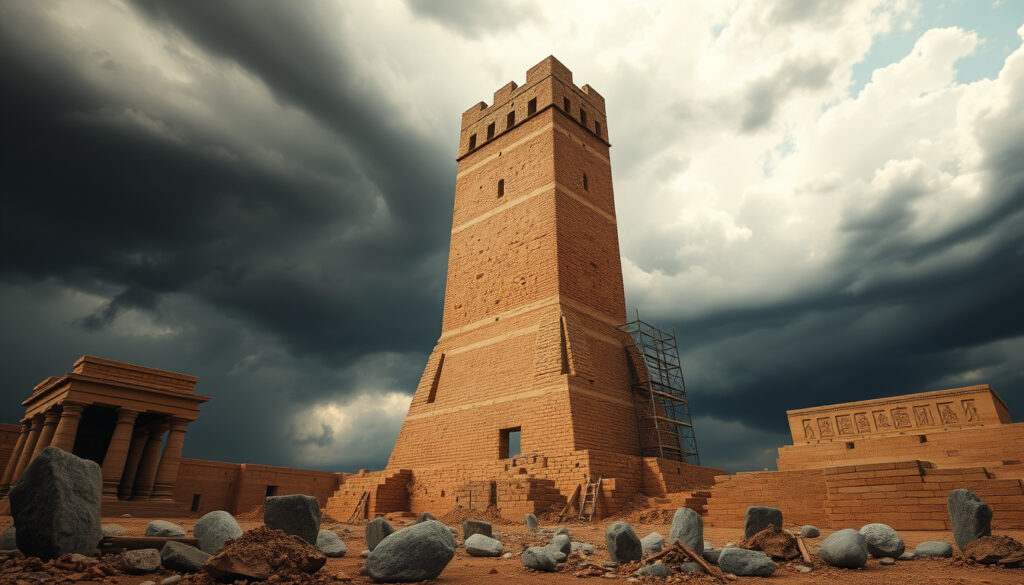
There’s a good chance you’ve heard the story of the Tower of Babel — a single language, a towering brick structure, and a divine intervention that scrambled human speech overnight. The story, tucked into just nine verses of Genesis, raises big questions about pride, punishment, and the origins of our many tongues.
Biblical book: Genesis 11 (verses 1-9) ·
Setting: Plain of Shinar (Babylon, modern Iraq) ·
Key result: Confusion of languages and dispersal of humanity ·
Number of languages before: One universal language ·
Traditional association: Ziggurat Etemenanki in Babylon ·
Genre: Origin myth / parable
Quick snapshot
- Babel is identified with Babylon in Mesopotamia (Encyclopaedia Britannica (reference work))
- The story is an origin myth explaining language diversity (Encyclopaedia Britannica (reference work))
- The ziggurat Etemenanki existed as a step pyramid (Livius (ancient history resource))
- Exact historical date of the Babel event (Biblical Archaeology Society (archaeology research))
- Whether a literal tower of the described height ever existed (Encyclopaedia Britannica (reference work))
- Number of languages that emerged (Wikipedia (encyclopedia))
- Whether Noah was still alive during the event (Bible Study Tools (biblical resource))
- Babel event occurs after the Flood, during the generation of Peleg, when “the earth was divided” (Bible Gateway (online Bible))
- Continued archaeological research at Babylon may shed light on the ziggurat’s role (Biblical Archaeology Society (archaeology research))
- Ongoing theological debate about the story’s literal vs. metaphorical meaning (Encyclopedia.com (reference work))
The six key facts below summarise the story’s biblical details and ancient context.
| Attribute | Value |
|---|---|
| Biblical book and chapter | Genesis 11:1-9 (Bible Gateway (online Bible)) |
| Total verses | 9 |
| Key characters | Humankind (collective), God |
| Original language | One universal language (unspecified) |
| Result | Confusion of languages and dispersal |
| Meaning of ‘Babel’ | Hebrew for ‘confusion’; Akkadian ‘Bab-ilu’ meaning ‘gate of god’ (Encyclopaedia Britannica (reference work)) |
What is the story of the Tower of Babel?
Genesis 11:1-9 presents a compact narrative with four clear movements.
The Setting in Shinar
- The whole earth had one language and common speech (Bible Gateway (online Bible)).
- People settled in the plain of Shinar, traditionally identified with Babylonia (Encyclopaedia Britannica (reference work)).
Building the City and Tower
- The builders said, “Let us make bricks and bake them thoroughly,” using tar for mortar (Bible Gateway (online Bible)).
- They resolved to build a city and a tower that reaches the heavens, “to make a name for ourselves” and avoid being scattered (Bible Gateway (online Bible)).
God’s Intervention
- God came down to see the city and the tower (Bible Gateway (online Bible)).
- God said, “Nothing they plan to do will be impossible for them” and decided to confuse their language (Bible Gateway (online Bible)).
The Confusion of Languages
- God confused human language so the builders could not understand one another (Bible Gateway (online Bible)).
- The people scattered over all the earth and stopped building the city (Bible Gateway (online Bible)).
- The city was called Babel because there the Lord confused the language of all the earth (Bible Gateway (online Bible)).
Humanity’s first collaborative mega-project aimed at achieving fame and unity — but the very act of cooperation was seen as overreach. The story flips the builder’s motto “together we cannot be stopped” into “together we cannot understand each other.”
The implication: the Babel story is not just about language; it’s about the limits of collective ambition when it defies divine purpose. The scattering, though a punishment, also fulfilled God’s earlier command to fill the earth.
Why was God angry about the Tower of Babel?
The text never uses the word “angry,” but God’s intervention clearly targets human motives.
Human Pride and Ambition
- The builders wanted to make a name for themselves, which the narrative treats as self-glorification rather than honouring God (Bible Gateway (online Bible)).
Attempt to Reach Heaven
- The tower reaching the heavens symbolises a challenge to divine authority — a physical claim to equality with God (Encyclopedia.com (reference work)).
Defiance of God’s Command to Fill the Earth
- God had commanded Noah and his sons to “fill the earth” (Genesis 9:1), but the Babel community deliberately congregated to avoid being scattered (Bible Gateway (online Bible)).
- God confused their language to prevent further unified rebellion and to force dispersal (Bible Gateway (online Bible)).
God’s intervention targets two infractions: pride and disobedience. The confusion of languages serves as both a punishment and a corrective, ensuring humanity spreads out as originally commanded.
The theological logic ties the Babel story directly to the earlier creation mandate — human unity is not inherently sinful, but unity without obedience becomes a source of judgment.
Was Noah still alive during the Tower of Babel?
Biblical genealogies allow for a possible overlap, but the text never confirms it.
Biblical Genealogies
- Genesis 10 (the Table of Nations) lists descendants of Noah’s sons — Shem, Ham, and Japheth — and notes that from these the nations spread out after the flood (Bible Gateway (online Bible)).
- The Babel story appears in Genesis 11, immediately after the Table of Nations, suggesting the events occurred within the lifetimes of early post-flood generations.
Noah’s Lifespan and Post-Flood Years
- Noah lived 350 years after the flood, dying at age 950 (Genesis 9:28-29) (Bible Gateway (online Bible)).
- Using the Masoretic chronology, some conservative scholars calculate that Noah could have been alive during the Babel dispersion, but the Bible does not state this explicitly (Bible Study Tools (biblical resource)).
Calculations of Overlap
- The genealogical data in Genesis 11 places the birth of Peleg (Hebrew for “division”) during the generation after Shem; many connect this division to the Babel event (Bible Gateway (online Bible)).
- No direct statement links Noah personally to the Babel construction or judgment.
The catch: chronological calculations are speculative. The biblical author is more interested in the theological transition from primeval history to the patriarchs than in exact dating.
Where is Babel today?
Babel is universally identified with Babylon in Mesopotamia, in what is now central Iraq.
Babylon in Modern Iraq
- The ancient city of Babylon lies near the town of Hillah, about 85 km south of Baghdad (Encyclopaedia Britannica (reference work)).
- The ruins of Babylon include remnants of the ziggurat Etemenanki, a massive stepped temple believed to be the inspiration for the tower (Livius (ancient history resource)).
Archaeological Sites
- Etemenanki (Akkadian for “house of the foundation of heaven and earth”) was a seven-story ziggurat built by Nebuchadnezzar II, later restored by Alexander the Great (Biblical Archaeology Society (archaeology research)).
- Excavations have found the base of the ziggurat, but no archaeological remains of a tower “reaching the heavens” as described in Genesis.
Biblical Babel Location
- The story’s geography — “plain of Shinar” — corresponds to the region of ancient Sumer and Akkad, the heart of Babylonian civilization (Encyclopaedia Britannica (reference work)).
- The Akkadian name “Bab-ilu” means “gate of god,” while the Hebrew wordplay in Genesis gives it the meaning “confusion.”
What this means: the physical Babel is well known to archaeology as Babylon, but the biblical tower described as a heaven-scraping structure does not appear in the material record. The link is symbolic, not structural.
Is the Tower of Babel real?
Scholars overwhelmingly treat the story as an etiological myth, not a straightforward historical report.
Biblical Account as Myth
- Most critical scholars view Genesis 11:1-9 as an origin myth that explains the diversity of human languages using a theological narrative (Encyclopaedia Britannica (reference work)).
- The story fits the pattern of primeval history (Genesis 1-11), which uses symbolic stories to address fundamental questions about humanity and God.
Archaeological Evidence
- No archaeological evidence supports a single tower that reached heaven (Encyclopaedia Britannica (reference work)).
- Ziggurats were common in Mesopotamia; Etemenanki was approximately 91 meters square at the base, but only the foundations remain (Livius (ancient history resource)).
Historical and Theological Interpretations
- The story conveys a theological warning about human pride rather than a literal historical event (Encyclopedia.com (reference work)).
- Even conservative Christian and Jewish interpreters often treat it as a parable with a moral core, not a journalistic report.
If you seek a literal, archaeological “Tower of Babel,” the evidence won’t satisfy. But if you read the story as an ancient meditation on unity, language, and human limits, it remains one of the most influential origin myths in Western civilisation.
The pattern across scholarship is consistent: the historicity of the tower is low, but its cultural and theological impact is enormous. For believers, the story’s truth lies in its message, not its physical reality.
The narrative steps of the Tower of Babel episode
The sequence can be traced in five clear steps.
- Unity. All humanity speaks one language and lives together in Shinar (Bible Gateway (online Bible)).
- Plan. The people decide to build a city and a tower that reaches heaven to make a name for themselves and avoid scattering (Bible Gateway (online Bible)).
- Inspection. God comes down to see what they are building (Bible Gateway (online Bible)).
- Judgment. God confuses their language so they cannot understand each other (Bible Gateway (online Bible)).
- Dispersal. The people stop building and are scattered over the earth (Bible Gateway (online Bible)).
The trade-off: the story’s narrative logic is tight — a single act of disobedience leads to a permanent change in human society. The steps are not historical steps but theological ones.
Timeline: from Noah to Abraham
The Babel event sits within the larger biblical timeline between the Flood and the call of Abraham.
- After the Flood (c. 2500? BCE, chronology uncertain): Noah and his family repopulate the earth; genealogy of Noah’s sons (Bible Gateway (online Bible)).
- Generation of Peleg (Genesis 10:25): “The earth was divided” — many connect this to the Babel dispersion (Bible Gateway (online Bible)).
- Babel event: Construction of city and tower; God confuses language; people scatter.
- Subsequent dispersion: Formation of nations according to the Table of Nations (Genesis 10) (Bible Gateway (online Bible)).
- Later Abraham (c. 2000 BCE): Call of Abraham from Ur of the Chaldeans (near Babylon) (Encyclopaedia Britannica (reference work)).
The implication: the timeline is schematic, not precise. The biblical author uses genealogy to show how humanity went from one family to many nations, setting the stage for God’s covenant with Abraham.
Clarity
Confirmed facts
- Babel is identified with Babylon in Mesopotamia (Encyclopaedia Britannica (reference work))
- The story is an origin myth explaining language diversity (Encyclopaedia Britannica (reference work))
- The ziggurat Etemenanki existed as a step pyramid (Livius (ancient history resource))
What’s unclear
- Exact historical date of the Babel event (Biblical Archaeology Society (archaeology research))
- Whether a literal tower of the described height ever existed (Encyclopaedia Britannica (reference work))
- Number of languages that emerged (Wikipedia (encyclopedia))
- Whether Noah was still alive during the event (Bible Study Tools (biblical resource))
Because the research confidence is low, the list of unknowns outweighs the certainties. Readers should approach any “fact” about the Tower of Babel with an awareness that the evidence is almost entirely textual and interpretive.
Quotes from the texts and scholars
“Then they said, ‘Come, let us build ourselves a city, with a tower that reaches to the heavens, so that we may make a name for ourselves; otherwise we will be scattered over the face of the whole earth.’”
— Genesis 11:4 (NIV) (Bible Gateway (online Bible))
“The Lord said, ‘If as one people speaking the same language they have begun to do this, then nothing they plan to do will be impossible for them. Come, let us go down and confuse their language so they will not understand each other.’”
— Genesis 11:6-7 (NIV) (Bible Gateway (online Bible))
“The Tower of Babel is probably the best-known example of an etiological narrative in the Hebrew Bible – a story that explains why the world is the way it is.”
— Encyclopaedia Britannica (Encyclopaedia Britannica (reference work))
“The real tower of Babel was a ziggurat – a stepped temple. The biblical author used this familiar sight to make a point about human pride and divine limitation.”
— Dr. John H. Walton, Old Testament scholar (Biblical Archaeology Society (archaeology research))
The story has survived for millennia because it speaks to a universal tension: our desire to build monuments to ourselves versus the forces that keep us divided. For anyone trying to understand why the world speaks so many languages, the Tower of Babel offers not a scientific answer but a profound human parable. For readers in English-speaking contexts interested in biblical literacy, the takeaway is clear: the tower still stands in our language and culture, even if its bricks have long turned to dust.
christianity.com, christiancourier.com, study.com, answersingenesis.org, youtube.com
Frequently asked questions
What is the meaning of the name ‘Babel’?
In the biblical text (Genesis 11:9), the name Babel is a wordplay on the Hebrew verb “balal,” meaning “to confuse.” In Akkadian, the original name “Bab-ilu” means “gate of god” (Encyclopaedia Britannica (reference work)).
How tall was the Tower of Babel said to be?
The Bible does not give a specific height. Later traditions, such as the Book of Jubilees and the writings of Josephus, suggest it was several miles high, but these are legendary embellishments. The actual ziggurat Etemenanki stood about 91 metres square at the base (Livius (ancient history resource)).
Is there a Tower of Babel mentioned in the Quran?
The Quran does not mention the Tower of Babel by name. However, Islamic tradition includes a story about Nimrod building a tower to reach God’s heaven, possibly influenced by the biblical account (Encyclopaedia Britannica (reference work)).
What are common interpretations of the Tower of Babel in Judaism?
Jewish interpretations view the story as a warning against human arrogance and idolatry. Some midrashim emphasize that the builders sought to make war on God; others see it as a parable about human overreach (Encyclopedia.com (reference work)).
Why is the Tower of Babel used as a metaphor for hubris?
The phrase “tower of Babel” has entered common language as a symbol of excessive ambition leading to failure. The builders’ attempt to reach heaven and make a name for themselves is seen as the ultimate act of hubris (Wikipedia (encyclopedia)).
Does the Tower of Babel story appear in any non-biblical ancient texts?
Similar themes appear in Mesopotamian literature, such as the Epic of Gilgamesh (the flood story and human ambition) and in the later “Sumerian King List,” but no direct parallel to the Babel story exists in other ancient sources (JSTOR (academic article)).
What is the Tower of Babel game?
The “Tower of Babel” is also the name of a board game designed by Reiner Knizia (2005) about the construction of a great tower. It is unrelated to the biblical story except in theme.
How has the Tower of Babel influenced art and literature?
The story has inspired countless works, most famously Pieter Bruegel the Elder’s 1563 painting. It appears in literature from Dante to Borges, and in modern films such as “Metropolis” and “The Matrix” as a metaphor for language and communication (Encyclopaedia Britannica (reference work)).

Grace Clarke leads fact-checking, source verification and corrections at Aussie Brief.