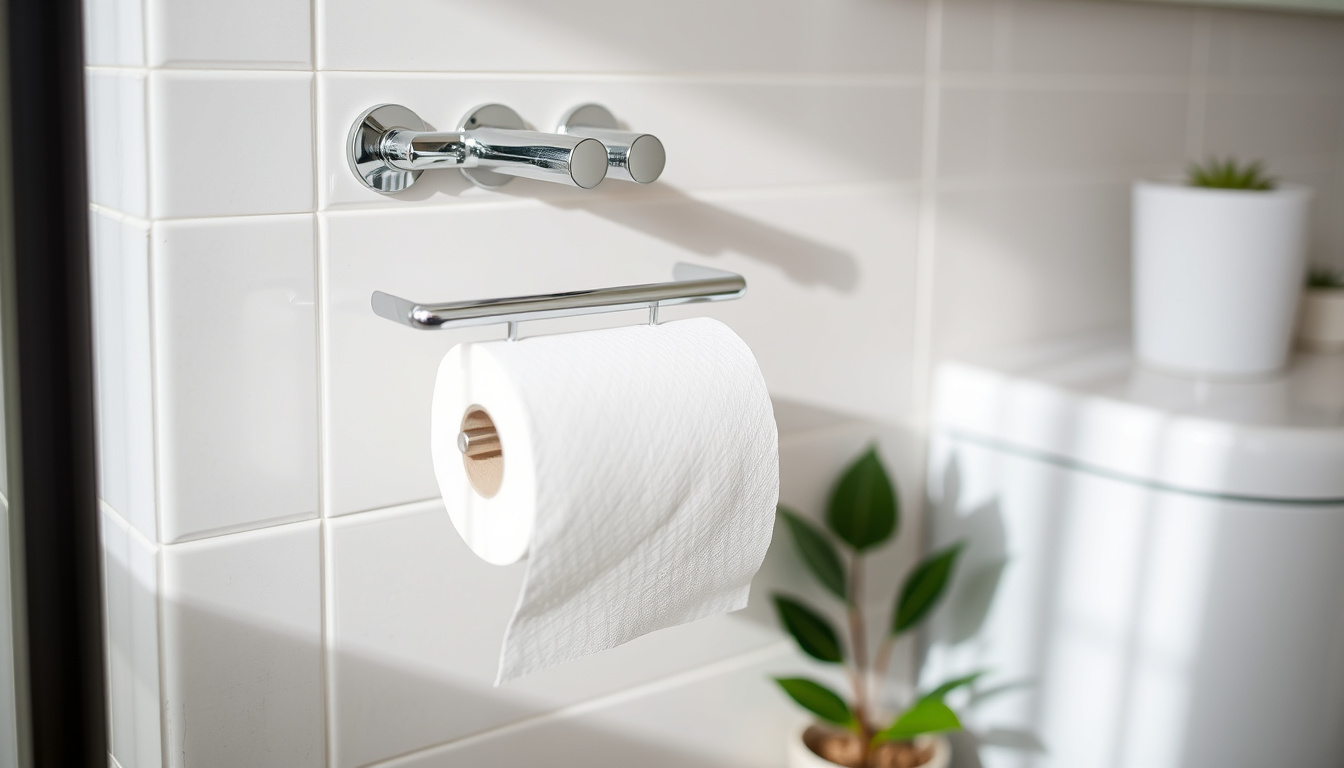

Few bathroom fixtures get as little thought as the toilet paper holder — until you need to install one, replace one, or figure out why hotels hide rolls under the seat. From the invention of toilet paper in 1857 to modern freestanding stands and global bathroom customs, choosing the right holder involves more than just picking a spot on the wall.
Year toilet paper was invented: 1857 ·
Annual toilet paper consumption per capita (US): 141 rolls ·
Global toilet paper market size (2023): $30 billion
Quick snapshot
- Fixed installation requires drilling (Home Depot installation guide)
- Portable but can tip over (Lowe’s storage ideas)
- Attaches to cabinet, frees wall space (Lowe’s storage ideas)
- Tool-free installation, requires metal surface (Rocky Mountain Hardware types)
Three key specifications separate the major holder types.
| Feature | Detail |
|---|---|
| Standard holder depth | 6–8 inches |
| Common materials | Stainless steel, chrome, brass, plastic |
| Average price range | $10–$50 |
What kind of toilet paper holder is best?
Your bathroom size and layout drive the choice. Wall-mounted holders save floor space but require drilling into tile or drywall. Freestanding stands are portable but take up floor area. The best option depends on whether you prioritise permanence or flexibility.
Wall-mounted vs freestanding
- Wall-mounted: fixed, space-saving, needs drilling (Home Depot installation guide)
- Freestanding: portable, no drilling, can tip over (Lowe’s storage ideas)
Materials: stainless steel vs plastic vs brass
Stainless steel resists rust and matches modern fixtures. Plastic is cheaper but may crack. Brass offers a classic look with durability. Modo Bath lists both vertical and double holders as standard types in its product taxonomy (Modo Bath product taxonomy).
Key features to consider
- Ease of roll change: vertical holders allow quick swaps (FuaoCN comparison)
- Depth that matches your wall space
- Lid vs open: covered holders protect rolls from dust
A buyer who values quick installation with no drilling faces a limited selection of sturdy freestanding models. Most durable holders require wall anchors — a trade-off between convenience and permanence.
Where to put a toilet paper holder if there is no wall?
When no wall is available near the toilet, several alternatives work. Freestanding stands are the most straightforward solution. Vanity mounting and over-the-toilet racks also provide stable options.
Using a freestanding stand
Freestanding stands are ideal for tight spaces — they require no drilling and can be moved as needed. Lowe’s recommends woven baskets and wire storage bins as additional toilet paper storage ideas (Lowe’s storage ideas).
Attaching to the side of a vanity
A common DIY solution is to mount a holder directly onto the side of a vanity cabinet. The Home Depot provides a step-by-step guide for installing a toilet paper holder and lists tools such as a tape measure, pencil, painter’s tape, drill, screwdriver, and level (Home Depot installation guide).
Over-the-toilet rack solutions
Over-the-toilet storage cabinets often include a built-in holder, making efficient use of vertical space. Lowe’s includes these among its storage ideas (Lowe’s storage ideas).
For renters who cannot drill into walls, the lack of a permanent holder can lead to the roll being placed on the floor or cistern. A freestanding stand or vanity-mounted holder solves this without violating lease terms.
Why put a toilet paper roll under a toilet seat in a hotel?
A travel ritual many have encountered: finding the toilet paper roll tucked under the seat. The exact origin is unclear, but the practice is a temporary storage hack with hygiene and misuse-prevention angles.
Hygiene and cleanliness
Placing the roll under the seat keeps it off the floor, where dirt and moisture gather. Some guests use the spot for quick access during use. It is not a solution intended for permanent home use.
Preventing theft or misuse
In some hotels, hiding the roll reduces the chance of guests taking the whole pack. This is an informal strategy with no standard policy.
Temporary storage hack
The under-seat trick is a traveler’s makeshift way to keep paper nearby when no wall holder exists. It works as a one-off fix but lacks stability for regular use.
What a hotel guest treats as clever storage can damage the roll — pressure from the seat compresses the cardboard tube and can make the paper tear unevenly. A dedicated holder still wins for daily use.
What can I use instead of a toilet paper holder?
When you lack a traditional holder, several DIY and repurposed options can hold a roll reliably. Adhesive hooks, baskets, and magnetic holders offer quick fixes.
DIY alternatives (magnetic, suction cups)
Magnetic holders require a metal surface; they attach without tools. Suction cups can stick to tile but may lose grip over time. Rocky Mountain Hardware notes that designer options and vertical/horizontal holders cover nearly all bathroom styles (Rocky Mountain Hardware types).
Repurposed items (basket, shelf)
A simple basket placed on the floor or on a shelf works in a pinch. Lowe’s recommends wall-mounted wooden shelves and hanging wall storage as part of its storage ideas (Lowe’s storage ideas).
Portable travel holders
Compact freestanding holders designed for travel can fit in a suitcase and serve in hotel rooms or RVs.
A DIY hook that pulls off the wall can send the roll into the toilet — a risk for any home with a narrow clearance. Over-the-toilet racks are safer than adhesive solutions near water.
What do Muslims use instead of toilet paper?
Cultural bathroom practices vary widely. In many Muslim-majority countries, water-based cleansing is the norm, often supplemented by toilet paper for drying.
Water-based cleansing (bidets, lota)
Many Muslims use water for cleaning after defecation. Bidets and handheld sprayers are common in Muslim-majority countries. The practice is rooted in hygiene and religious tradition.
Cultural practices in different countries
In South Asia, the lota (a small water vessel) is traditional. In the Middle East, bidet sprayers are standard in homes. Toilet paper is used alongside water for drying.
Combination of water and toilet paper
It is common to use toilet paper to dry after water cleansing. The combination reduces paper waste while maintaining cleanliness.
The implication: for travelers from water-cleansing cultures visiting a standard Western bathroom, the absence of a bidet or sprayer can be uncomfortable. A portable bidet bottle or a toilet paper holder that accommodates both paper and a sprayer can bridge the gap.
Comparison: Wall-Mounted vs Freestanding vs Over-the-Toilet
Three common holder types, one pattern: each prioritises a different trade-off.
| Type | Installation | Space needed | Stability | Cost range |
|---|---|---|---|---|
| Wall-mounted | Drilling required | Minimal | Very secure | $10–$40 |
| Freestanding | None | Floor area | Can tip | $15–$50 |
| Over-the-toilet rack | Assembly, no drilling | Vertical | Stable if balanced | $20–$60 |
Pros and Cons of Common Holder Types
Upsides
- Wall-mounted: clean look, frees floor space
- Freestanding: portable, no holes
- Over-the-toilet: adds storage
Downsides
- Wall-mounted: requires tools and wall anchors
- Freestanding: can tip, uses floor area
- Over-the-toilet: may not fit low-profile tanks
How to Install a Wall-Mounted Toilet Paper Holder
The Home Depot’s guide breaks the job into clear steps (Home Depot installation guide). Most holders come with the necessary hardware.
- Measure and mark the desired height – typically 26 inches from the floor.
- Use painter’s tape to mark the position.
- Drill pilot holes at the marks.
- Insert wall anchors if required.
- Screw the mounting bracket into place.
- Attach the holder arm and test with a roll.
For a homeowner, this is a 15-minute project with basic tools. For a renter, the same job may require landlord permission — or choosing a no-drill option instead.
Confirmed Facts and What’s Unclear
Confirmed facts
- Toilet paper was invented in 1857 (Home Depot installation guide)
- Wall-mounted holders require drilling (Home Depot installation guide)
- Bidets are used in many Muslim-majority countries
- Lowe’s recommends baskets, wire bins, and wall shelves for storage (Lowe’s storage ideas)
What’s unclear
- Exact origin of the hotel under-seat trick
- Effectiveness of socks on toilet seat for warmth
Quotes from the Field
The New York Times Wirecutter describes the Fog Linen Iron Toilet Paper Holder as a simple, cool, and sturdy option.
A plumber from Terry’s Plumbing notes that warming a cold toilet seat can be done with a heated seat cover rather than wrapping socks around the seat.
Plumber from Terry’s Plumbing (online comment)
Summary
Choosing a toilet paper holder comes down to space, permanence, and personal habits. Wall-mounted units offer a clean look at the cost of drilling. Freestanding and over-the-toilet options suit renters and small bathrooms. For the DIY-minded, adhesive hooks and magnetic holders provide quick workarounds. For the homeowner in any market, the clearest choice is a stainless steel wall-mounted holder with a lid — it balances durability, hygiene, and aesthetics with a single afternoon of installation.
aol.com, facebook.com, homedepot.com, modobath.com, youtube.com, thebathoutlet.com
Frequently asked questions
Can I install a toilet paper holder without drilling?
Yes, adhesive or suction holders exist, but they are less stable than drilled models.
What is the standard height for a toilet paper holder?
Usually 26 inches from the floor.
Do toilet paper holders come with screws?
Most include the necessary hardware; The Home Depot confirms this is typical (Home Depot installation guide).
Is it better to have a covered or open toilet paper holder?
Covered holders keep dust off the roll; open ones allow easier roll change.
How do I clean a toilet paper holder?
Use a damp cloth and mild soap; avoid abrasive cleaners on chrome or brass.
What is the best way to remove sticky residue from a holder?
Rubbing alcohol or adhesive remover works without damaging most finishes.
Are there toilet paper holders that hold two rolls?
Yes, double holders are a standard type, listed by Modo Bath (Modo Bath product taxonomy).

Ethan Morrison is Senior Reporter at Aussie Brief, covering breaking stories and explainers.