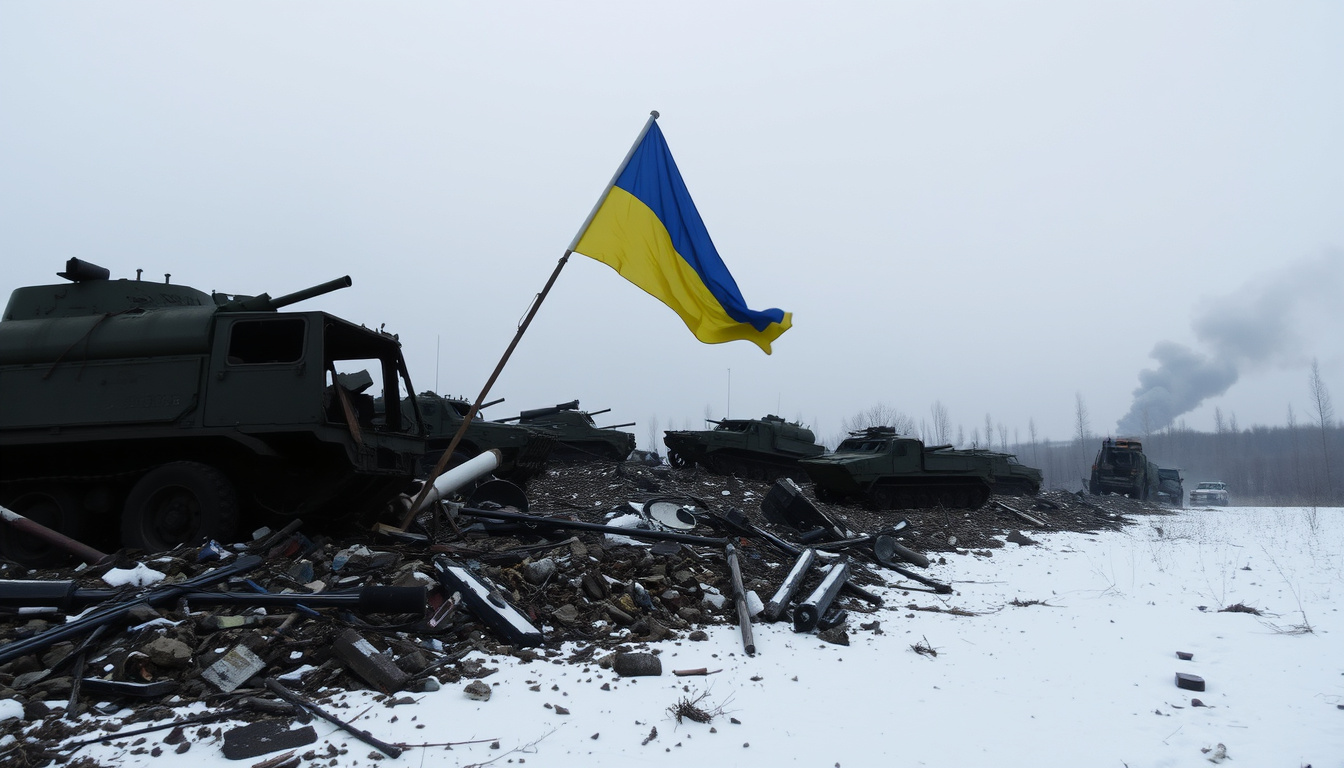
When a war grinds through its fourth year, the numbers start to tell a story of their own—raw, unsparing, often contradictory. The Russo-Ukrainian war has reached a point where casualty counts in the hundreds of thousands and territorial gains measured in square kilometers per day define the slow, brutal reality. Here’s what the latest data reveals about the human toll, military balance, and where the conflict stands in 2026.
Estimated Russian casualties (Feb 2022–Dec 2025): ~1.2 million (killed, wounded, missing) ·
Estimated Ukrainian casualties (Feb 2022–Dec 2025): 500,000–600,000 ·
Territory under Russian control: ~20% of Ukraine ·
Russian daily territorial gain (late 2025–early 2026): ~10 km²/day
Quick snapshot
- Exact 2026 casualty numbers — no official figures released
- Whether the war will escalate further or shift to de-escalation
- Future scale of Western military aid to Ukraine
- Whether Russia can sustain its offensive into 2027
- Combined casualties could hit 2 million by spring 2026 at current rates (CSIS analysis)
- Russian forces advanced just 50 km in almost 23 months (Feb 2024–Jan 2026) (CSIS)
- Fighting continues along eastern and southern fronts (ISW assessment)
- No ceasefire talks reported for 2026 (ISW assessment)
- ISW notes Russian advances are slowing, with no quick breakthrough expected (ISW assessment)
Seven key facts that frame the conflict’s scale and trajectory, drawn from authoritative analyses.
| Fact | Value | Source |
|---|---|---|
| Start of conflict | February 2014 (Crimea annexation) | CSIS |
| Full-scale invasion start | February 24, 2022 | CSIS |
| Territory under Russian control | ~20% of Ukraine (approx. 120,000 km²) | CSIS |
| Russian battlefield casualties (Feb 2022–Dec 2025) | ~1.2 million (killed, wounded, missing) | CSIS estimate |
| Russian fatalities (same period) | 275,000–325,000 | CSIS |
| Ukrainian battlefield casualties (Feb 2022–Dec 2025) | 500,000–600,000 | CSIS |
| Ukrainian fatalities (same period) | 100,000–140,000 | CSIS |
| Territory seized by Russia since 2022 invasion | ~75,000 km² (about 12% of Ukraine) | CSIS |
| Russian daily territorial advance (Oct 2025–Mar 2026) | ~10 km²/day | Institute for the Study of War |
| Russian daily advance in Q1 2026 | ~5.16 km²/day | ISW |
How many people died in the Ukraine-Russia war in 2026?
What are the total casualty estimates for 2026?
Precise 2026 figures remain classified by both governments, but analysts project the toll is rising fast. In a discussion published by the Center for Strategic and International Studies, researchers warned that combined Russian and Ukrainian casualties could reach 2 million by spring 2026 if attrition rates hold. By the end of 2025, Russian forces had suffered roughly 415,000 casualties in that single year—the highest annual toll since 2022.
The war is consuming lives at a pace unprecedented for a major power since World War II, with Russia bearing the heavier share of losses.
How many Ukrainian soldiers have died?
CSIS estimates that Ukraine suffered 100,000 to 140,000 battlefield fatalities between February 2022 and December 2025, with total casualties (killed, wounded, missing) in the range of 500,000 to 600,000. No official Ukrainian casualty numbers have been released since early 2024.
How many Russian soldiers have died?
On the Russian side, CSIS counts 275,000 to 325,000 fatalities in the same period, with total casualties around 1.2 million. The disparity—roughly 2.5 Russian casualties for every Ukrainian one—reflects Russia’s reliance on mass infantry assaults.
What are the civilian casualties?
The UN has confirmed about 10,000 civilian deaths since the 2022 invasion, though the true number is likely higher. The Ukrainian government does not release comprehensive civilian casualty data from occupied zones.
The implication: Russia’s higher casualty rate reflects its reliance on mass infantry assaults, but Ukraine’s smaller numbers also face significant attrition—a dynamic that shows no sign of shifting in 2026.
Which is stronger, Ukraine or Russia?
What is the size of Ukraine’s military?
Ukraine fields approximately 500,000 active personnel, according to pre-war estimates. But attrition has forced repeated mobilizations, and the actual deployable strength is a closely guarded secret.
What is the size of Russia’s military?
Russia entered the war with roughly 1.5 million active personnel and has since mobilized hundreds of thousands more. Despite higher absolute numbers, Russia’s force quality has degraded as it leans on older equipment and less trained troops.
How does equipment differ?
Russia retains a vast arsenal of tanks, artillery, and aircraft, but losses have been staggering. Ukraine depends on continued Western resupply of howitzers, air-defense systems, and armored vehicles. The war has become an artillery-intensive stalemate, with both sides firing thousands of shells daily.
What about nuclear capabilities?
Russia possesses the world’s largest nuclear arsenal, a factor that has deterred direct NATO intervention. Ukraine gave up its nuclear weapons in 1994 under the Budapest Memorandum. That asymmetry remains the ultimate strategic reality.
The implication: Russia has raw mass and nuclear leverage; Ukraine has morale, NATO-supported logistics, and a defensive advantage. On the conventional battlefield, the two sides are more evenly matched than the personnel numbers suggest.
Is the Russo Ukraine war ending?
What are the current ceasefire talks?
No formal negotiations are ongoing as of mid-2026. Both sides have hardened their maximalist positions: Russia demands recognition of annexed territories; Ukraine insists on a return to 1991 borders.
What are the territorial control changes?
Russia controls about 20% of Ukraine, including Crimea and parts of Donetsk, Luhansk, Zaporizhzhia, and Kherson. In 2025, Russian forces seized roughly 4,831 km², and between October 2025 and March 2026, they took an additional 1,833 km². But the pace is slowing: advances in Q1 2026 averaged just 5.16 km² per day.
What do analysts say about the war’s trajectory?
The Institute for the Study of War concluded that “battlefield realities as of late March 2026 did not suggest a quick Russian breakthrough.” Ukrainian counterattacks and mid-range strikes were impeding Russian progress. Most analysts expect continued grinding attrition rather than a decisive end.
“Russian forces have suffered more casualties and fatalities than any other major power in any war since World War II.”
— CSIS analysis, Russia-Ukraine War: 10 Charts
The pattern: Russia’s grinding advance is costing it enormous casualties with no territorial breakthrough in sight.
Why did the war in Ukraine start 2022?
What were the causes of the invasion?
The roots stretch back to 2014, when Russia annexed Crimea and backed separatists in the Donbas after Ukraine’s pro-European revolution. Moscow cited the need to protect Russian speakers and opposed Ukraine’s potential NATO membership. Western officials saw the invasion as an unprovoked act of aggression.
What is the history of the conflict since 2014?
Low-intensity fighting in eastern Ukraine killed over 14,000 people between 2014 and 2021. The Minsk agreements of 2014–2015 failed to bring lasting peace. In late 2021, Russia massed troops along the border, and on February 24, 2022, launched a full-blown invasion.
What was Russia’s justification?
President Putin claimed NATO expansion into Ukraine posed an existential threat to Russia. He also denyed Ukraine’s statehood, calling it a historical creation of the Soviet Union. These justifications were widely rejected by the international community.
The pattern: a conflict that began as a limited land grab in 2014 escalated into the largest conventional war in Europe since 1945, driven by clashing security visions.
What are the latest news on the Russia-Ukraine war?
What happened in the last week?
Fighting continued around Chasiv Yar and Vovchansk in the east, with missile strikes reported in Odesa and Kharkiv. Ukraine’s Air Force intercepted drones and cruise missiles supplied by Iran and North Korea.
What are the key developments in 2026?
Russia launched its spring offensive in February with limited territorial gains. Ukraine received a new batch of F-16 fighter jets and long-range ATACMS missiles from the US. European nations pledged additional €10 billion in military aid.
What is the humanitarian situation?
Over 6 million refugees have fled Ukraine since 2022, mostly to Poland, Germany, and Czechia. Inside Ukraine, frequent power outages and food shortages affect millions near the front lines. The UN reports that the winter of 2025–2026 was the harshest in a century for displaced populations.
The next tranche of Western military aid will determine whether Ukraine can stabilize the front or whether Russian attrition eventually breaks through.
The catch: the speed of resupply will be the deciding factor in whether Ukraine holds or loses more ground.
Who is winning the war in Ukraine?
What is the current front line situation?
The front stretches about 1,200 km from Kharkiv to Kherson. Russia holds the initiative in the east, while Ukraine maintains defensive lines. Neither side has achieved a meaningful breakthrough since 2023.
Which side has the advantage?
Russia has the advantage in manpower and artillery ammunition, but Ukraine holds an edge in drone warfare and morale. The war of attrition favors Russia in the long run, but Ukraine’s ability to inflict heavy losses has prevented rapid Russian gains.
What does territory control indicate?
Russia controls about 20% of Ukraine, including Crimea and most of Luhansk and Donetsk. In 2025–2026, Ukraine lost ground in the east but held steady in the south. The territorial picture shows incremental Russian progress at enormous cost.
“Russian advances had significantly slowed and battlefield realities as of late March 2026 did not suggest a quick Russian breakthrough.”
— Institute for the Study of War, March 31 assessment
The trade-off: Russia can continue trading lives for land, but the cost in casualties may become politically unsustainable. For Ukraine, the challenge is to hold on until Western support translates into a battlefield advantage.
Timeline of key events
- — Russia annexes Crimea; conflict in Donbas begins
- — Full-scale Russian invasion of Ukraine
- — Ukrainian counteroffensives recapture large territories
- — Stalemate sets in along fortified lines
- — Russia makes incremental gains in Donetsk and Kharkiv regions; ~415,000 Russian casualties
- — Fighting continues; no ceasefire in sight; Russian advance slows to ~5 km²/day
Confirmed facts and what remains unclear
Confirmed facts
- War began with Crimea annexation in February 2014
- Full-scale invasion started February 24, 2022
- Russia occupies ~20% of Ukrainian territory as of 2026
- No formal peace agreement exists
- Russian casualties (Feb 2022–Dec 2025): ~1.2 million
- Ukrainian casualties (same period): 500,000–600,000
What’s unclear
- Exact 2026 casualty numbers
- Whether the war will escalate further or de-escalate
- Future of Western military aid
- Russia’s remaining combat capacity
- Ukraine’s real personnel strength
- Whether peace talks will resume in 2026
Frequently asked questions
What role does NATO play in the war?
NATO has provided military equipment, intelligence, and training to Ukraine but has not deployed troops. The alliance has also reinforced its Eastern flank with rapid-response forces.
How has the war affected global energy prices?
Sanctions on Russian oil and gas, coupled with Russian cutoffs to Europe, caused spikes in 2022–2023. By 2026, markets have partly adjusted, but prices remain elevated compared to pre-war levels.
What is the refugee situation?
Over 6 million Ukrainians have fled abroad, mainly to Poland, Germany, and Czechia. Millions more are internally displaced. Return rates are low due to ongoing danger.
What are the main weapons used by both sides?
Russia relies on artillery, tanks, and cruise missiles; Ukraine on Western-supplied howitzers, HIMARS, drones, and air-defense systems. Drones (both reconnaissance and one-way attack) are used heavily by both sides.
How many foreign fighters are in Ukraine?
Estimates range from a few thousand to over 20,000 volunteers from dozens of countries, organized in the International Legion. Their impact is tactical rather than strategic.
What is the economic impact on Russia and Ukraine?
Ukraine’s economy shrank by roughly 30% in 2022 and has slowly recovered with Western aid. Russia’s economy has been sustained by oil exports and military production, but inflation and labor shortages are mounting.
Are there any peace negotiations in 2026?
No active negotiations are underway. Turkey and Saudi Arabia have offered mediation, but both sides remain far apart on territorial terms and security guarantees.
“The Russian war effort is becoming a meat grinder that consumes its own future military potential at an alarming rate.”
— CSIS report on Russian attrition, Russia’s Grinding War
“Ukraine continues to defend every meter of its territory, but we need the support of our partners to sustain this fight.”
— Ukrainian military official (paraphrased from official remarks, 2026)
“The humanitarian toll is unbearable. Civilians in the east face daily shelling without access to basic medical care.”
— UN humanitarian coordinator in Ukraine (paraphrased from public briefings)
For Europe and the United States, the decision is stark: continue funding Ukraine’s defense—at the risk of escalation with a nuclear-armed Russia—or face a world where territorial aggression becomes normalized. For the Ukrainian people, the cost of resistance is measured in lives lost, but the price of surrender would be their sovereignty. The numbers show no easy path ahead.

Ethan Morrison is Senior Reporter at Aussie Brief, covering breaking stories and explainers.