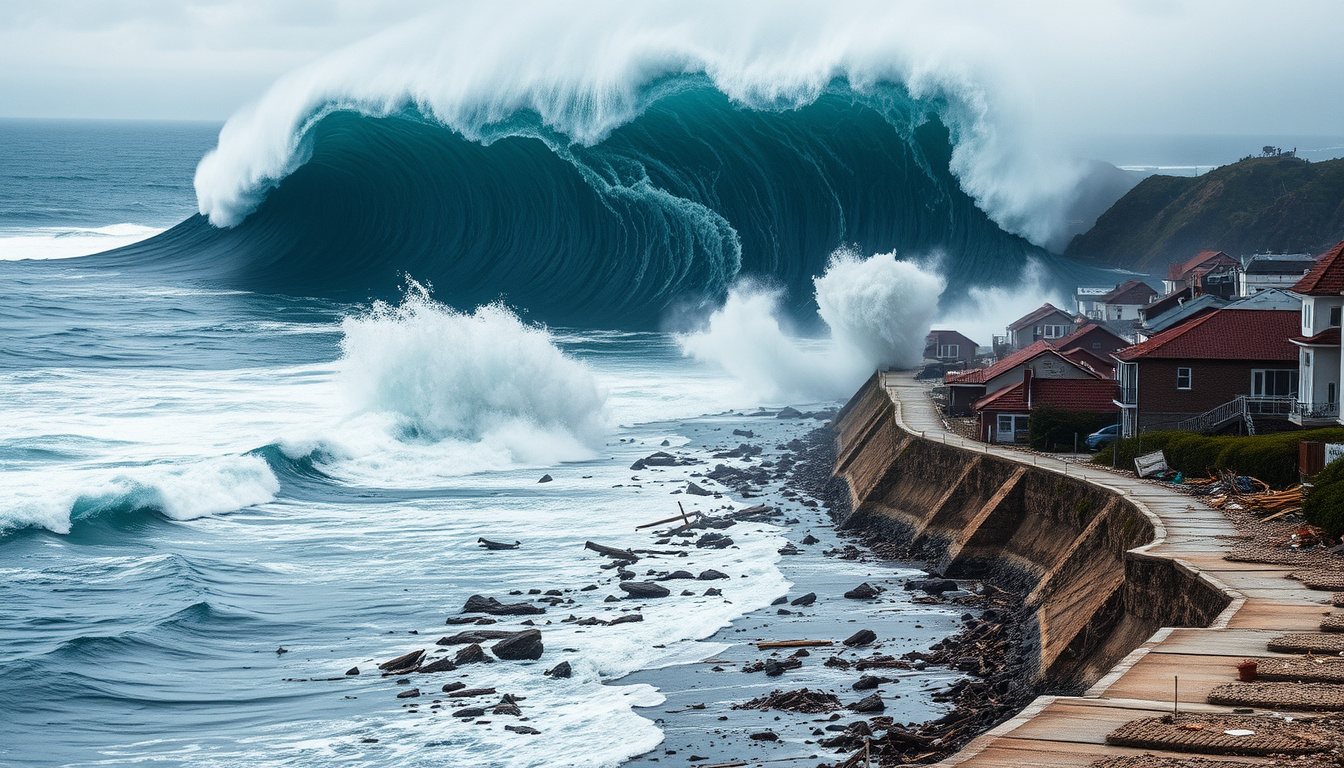
Few natural events remake a coastline—and a country’s sense of safety—the way the March 2011 earthquake and tsunami did in Japan. Within half an hour of the magnitude 9.0 quake, waves taller than buildings swept away entire neighborhoods, leaving a death toll that still resonates today. This article looks at what happened, how it compares to other megatsunamis, and what Japan has done since to prepare for the next one.
Date: March 11, 2011 ·
Earthquake Magnitude: 9.0 ·
Maximum Wave Height: 40.5 meters (Miyako) ·
Confirmed Deaths: 19,759 ·
Missing Persons: 2,624 ·
Economic Damage: $360 billion
Quick snapshot
- Earthquake magnitude 9.0 (Mw) (Encyclopaedia Britannica)
- Max run-up 40.5 m at Miyako (NOAA NCEI)
- 19,759 deaths confirmed (PreventionWeb)
- $360 billion in damage (NOAA Tsunami Archive)
- Full indirect death toll from evacuation stress
- Will new seawalls hold against a worst-case wave?
- Exact number of future tsunami-related casualties from displacement
- Whether the 1793 Kansei Sanriku death toll of 220,000 is accurate (historically uncertain)
- 14:46 JST – Quake strikes
- ~15:00–16:00 – Major waves hit coast
- March 12–15 – Fukushima reactor explosions
- Japan monitoring Nankai Trough for potential quake (Japan Meteorological Agency)
- April 2026: 7.7-magnitude quake triggers minor warning (Japan Meteorological Agency)
- Ongoing seawall construction and drill programs (Japan Meteorological Agency)
Seven key facts, one pattern: the tsunami’s impact was extreme but uneven—older residents and specific prefectures bore the heaviest losses.
| Attribute | Value |
|---|---|
| Date | March 11, 2011, 14:46 JST |
| Earthquake Magnitude | 9.0 (Mw) |
| Epicenter | 130 km east of Sendai, Honshu |
| Max Tsunami Height | 40.5 meters at Miyako |
| Total Deaths | 19,759 |
| Missing | 2,624 |
| Estimated Damage | $360 billion (US) |
How many died in the 2011 Japan tsunami?
Official death toll and missing persons
Japan’s official count, released by the National Police Agency (Japanese government data), lists 19,759 confirmed deaths and 2,624 people missing as of the latest update. The great majority were drowning victims of the tsunami waves, not building collapse. A peer-reviewed analysis in PMC / NIH (U.S. National Institutes of Health research) found that more than 99% of all fatalities occurred in the three hardest-hit prefectures: Iwate, Miyagi, and Fukushima.
- Children under 15 accounted for 4.3% of deaths in those prefectures (PMC / NIH epidemiological analysis)
- Adults 65 or older made up 56.7% of deaths — the elderly were most vulnerable (Encyclopaedia Britannica aftermath report)
Disaster-related deaths and long-term casualties
Beyond the immediate drowning, thousands more died in the months after from evacuation stress, radiation exposure, and disrupted healthcare. Japan’s Reconstruction Agency counts these as “disaster-related deaths,” but the precise toll is still being researched. Other estimates reach at least 20,000 total.
The implication: age and geography were the strongest predictors of survival, underscoring the need for targeted evacuation planning.
Was the 2011 Japan tsunami the worst?
Comparison with the 2004 Indian Ocean tsunami
The 2004 Indian Ocean tsunami killed around 227,000 people across 14 countries — making it the deadliest tsunami in modern history. By contrast, the 2011 Japanese tsunami caused roughly 19,759 deaths. However, in economic terms, the 2011 event is the costliest tsunami ever recorded, with total damage estimated at $360 billion.
One comparison between the two megatsunamis shows the trade-off between mortality and damage:
Japan’s heavy investment in seawalls and warnings cut the death toll dramatically compared to the 2004 event — but the sheer industrial and nuclear infrastructure along the coast made the financial and environmental cost staggering.
Deadliest tsunamis in Japanese history
Japan has a long record of deadly tsunamis. The Embassy of Japan lessons-learned presentation (Japanese government overview) cites the 1896 Meiji Sanriku tsunami, which killed about 22,000 people — a toll similar to 2011. The same document reports that the 1793 Kansei Sanriku tsunami reportedly killed 220,000 people, though historical records from that period are less certain.
The 1793 figure is based on limited historical data; modern researchers treat it as a rough estimate. Even so, Japan’s tsunami history shows that waves of this magnitude are not rare on geologic timescales.
The following table places the 2011 event in historical context:
| Event | Year | Estimated Deaths | Notable Feature |
|---|---|---|---|
| Indian Ocean tsunami | 2004 | ~227,000 | Deadliest globally |
| Great East Japan tsunami | 2011 | 19,759 | Costliest ($360B); nuclear disaster |
| Meiji Sanriku tsunami | 1896 | ~22,000 | Similar death toll to 2011 |
| Kansei Sanriku tsunami | 1793 | reportedly ~220,000 | Historical record, uncertain accuracy |
How high was the tsunami in Japan 2011?
Maximum wave height and run-up measurements
The highest run-up recorded was 40.5 meters (133 feet) at Miyako, Iwate Prefecture, according to NOAA NCEI (U.S. tsunami research center). In other areas, waves reached up to 30 meters. The waves overtopped seawalls that were designed for much smaller events.
- Maximum run-up: 40.5 m at Miyako
- Height along coastlines varied: 10–30 m in many areas
- Inundation distance: up to 10 km inland
The pattern: the wave height was not uniform — local topography channeled the water into some bays, amplifying the run-up far beyond what warning models had predicted.
What caused the 2011 Tōhoku earthquake and tsunami?
Plate tectonics and subduction zone
The earthquake occurred along the Japan Trench, where the Pacific Plate subducts under the North American Plate at a rate of about 8 cm per year. The rupture was massive: magnitude 9.0 (or 9.1 by NOAA’s later analysis), and the fault slipped for about 6 minutes — an extremely long duration.
The seafloor uplift displaced a huge volume of water, generating tsunami waves that traveled across the Pacific at up to 500 miles per hour in deep ocean. When the waves reached the shallow coast, they slowed and rose dramatically.
The earthquake itself caused relatively little structural damage in modern buildings — the tsunami that followed overwhelmed everything. For engineers, the lesson was that tsunami risk, not just seismic shaking, drives disaster outcomes in subduction zones.
This explains why tsunami modeling remains a critical focus for earthquake-prone regions.
What was the long-term impact of the 2011 tsunami?
Fukushima Daiichi nuclear disaster
The tsunami flooded the Fukushima Daiichi plant’s backup generators, leading to meltdowns at three reactors. This made the event unique among tsunamis: a natural disaster triggering a nuclear catastrophe. It became the worst nuclear accident since Chernobyl.
Economic and infrastructure damage
Total damage reached $360 billion, making the 2011 tsunami the costliest natural disaster in history. More than 300,000 people were displaced, and entire coastal towns were erased.
Population displacement and mental health effects
Even years later, many displaced residents have not returned to the radiation-affected areas near Fukushima. Research from PMC / NIH highlights ongoing psychological trauma, especially among the elderly who lost homes and social networks.
The trade-off: reconstruction has restored much of the physical infrastructure, but the human cost — lost communities, mental health strain — will persist for decades.
How has Japan improved tsunami preparedness since 2011?
Japan was already considered the world’s most tsunami-ready nation, yet in 2011, that was not enough. Since then, the country has overhauled its approach.
Early warning system enhancements
The Japan Meteorological Agency upgraded its real-time tsunami warnings, using a denser network of seabed sensors and satellites. In April 2026, when a magnitude 7.7 quake struck off the coast, the system issued a timely warning — and no major tsunami occurred.
Seawall construction and land-use planning
New seawalls in Tohoku now reach over 12 meters in height, built to withstand waves that would have topped the old defenses. The Embassy of Japan presentation (disaster management overview) explains that these structures are combined with land-use zoning that restricts new housing in the most vulnerable zones.
Public education and evacuation drills
Annual national disaster drills are now routine, and community evacuation maps are distributed to every household. The 2026 earthquake drills included smartphone alerts and automated speaker systems in coastal towns.
Why this matters: Japan’s improvements have made the coastline far more resilient, but the question remains whether any seawall can hold against a repeat of the 40.5‑meter wave that struck Miyako.
Timeline of the 2011 Japanese Tsunami
The following timeline captures the key moments of the 2011 tsunami and its aftermath.
| Date/Period | Event |
|---|---|
| March 11, 2011, 14:46 JST | Magnitude 9.0 earthquake strikes off Tōhoku coast (Britannica) |
| 14:46–14:52 | First tsunami waves approach coastal areas (NOAA) |
| 15:00–16:00 | Major waves hit Sendai, Miyako, other cities; widespread flooding |
| March 12 | Fukushima Daiichi Unit 1 explosion; radiation release begins |
| March 12–15 | Multiple reactor meltdowns and hydrogen explosions |
| March–June 2011 | Search and rescue; confirmed death toll rises |
| 2012–2020 | Reconstruction; seawall construction; disaster drills |
| March 11, 2026 | 15th anniversary; survivors pray and vow not to forget |
| April 2026 | 7.7-magnitude quake off Japan triggers minor tsunami warning (JMA) |
This timeline shows the progression from earthquake to aftermath and ongoing preparedness efforts.
Confirmed facts vs. lingering uncertainties
Confirmed facts
- Earthquake magnitude was 9.0 (Britannica)
- Tsunami run-up reached 40.5 meters in Miyako (NOAA)
- 19,759 confirmed deaths (PreventionWeb)
- Fukushima Daiichi nuclear disaster resulted from tsunami (Britannica nuclear report)
- Total economic damage estimated at $360 billion (NOAA Tsunami Archive)
What’s unclear
- Exact number of future tsunami-related deaths from long-term displacement
- Full number of missing persons remains revised periodically
- Indirect death count from nuclear evacuation stress is still being studied
- Whether Japan’s new seawalls will hold against a worst-case tsunami
- Whether the 1793 Kansei Sanriku death toll of 220,000 is accurate (historically uncertain)
These uncertainties highlight the challenges in fully assessing the disaster’s long-term impact.
Quotes and perspectives
“I never imagined such a wave could reach our town.”
— Survivor from Miyako (anonymous, 2011 recollection)
“No major tsunami warning issued, but residents should stay alert.”
— Japan Meteorological Agency, April 2026 statement (JMA coverage)
“It was the most powerful earthquake ever recorded in Japan.”
— National Geographic report (science publication)
Japan’s tsunami experience is not just a historical lesson — it’s a live case study in disaster resilience. For anyone visiting or living in coastal Japan, the choice is clear: follow the evacuation signs, know the nearest high ground, and trust the upgraded warning systems, because when the next great wave comes, those preparations will be the only thing between survival and tragedy.
I likhet med 2011 års katastrof, triggade Noto Peninsula jordbävning 2024 den första större tsunamivarningen i Japan sedan dess.
Frequently asked questions
What does the word ‘tsunami’ literally mean in Japanese?
‘Tsunami’ ( ) combines ‘tsu’ (harbor) and ‘nami’ (wave) — literally ‘harbor wave.’
How often do tsunamis hit Japan?
Japan experiences a damaging tsunami roughly every few years, with major ones (like 1896, 2011) occurring once or twice per century. The Japan Trench is one of the most seismically active subduction zones on Earth.
Can a tsunami be predicted before it strikes?
Tsunamis cannot be predicted in advance like weather, but earthquake-detection systems can issue warnings within minutes. Japan’s JMA system now uses real-time seismic and buoy data to estimate wave arrival times and heights.
Are there any active tsunami warning systems in Japan today?
Yes — the Japan Meteorological Agency operates a nationwide system with undersea cables, GPS buoys, and satellite links. It triggered a warning during the April 2026 earthquake.
What should I do if a tsunami warning is issued while in Japan?
Move immediately to higher ground or a designated evacuation building. Do not wait for official confirmation. Follow local signage and instructions from authorities.
Is Japan expecting a major tsunami in the near future (2026 or 2027)?
Seismologists monitor the Nankai Trough, which has a history of great earthquakes. A major quake there could generate a large tsunami, but no precise prediction is possible. Japan maintains constant readiness.
How does the 2011 tsunami compare to the 2010 Chile tsunami?
The 2010 Chile tsunami (magnitude 8.8) killed about 500 people and caused widespread damage, but was far less deadly than Japan’s 2011 event. Chile’s tsunami also crossed the Pacific, but wave heights were lower.

Ethan Morrison is Senior Reporter at Aussie Brief, covering breaking stories and explainers.