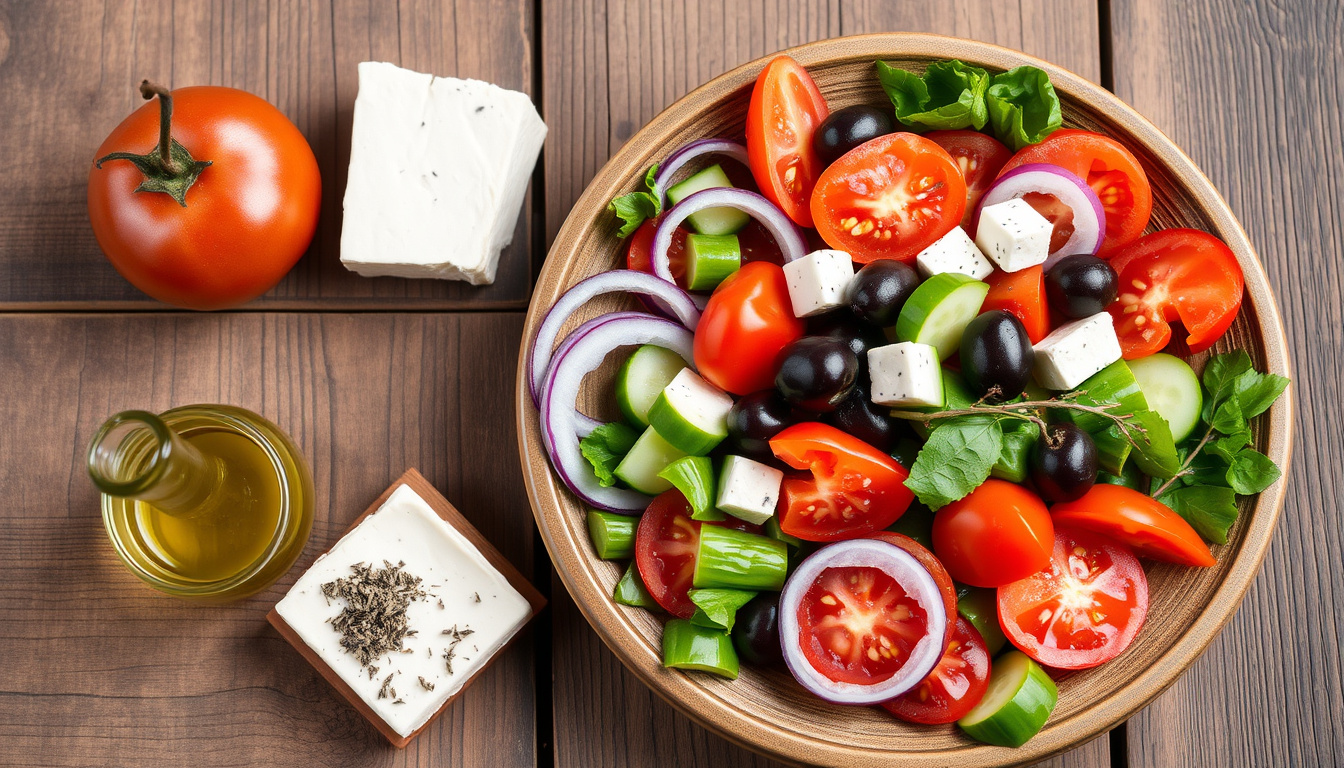

There’s something about a Greek salad that feels like a mini vacation — bright tomatoes, briny olives, and a slab of creamy feta soaking in olive oil, but if you’re managing diabetes or keeping an eye on kidney health, you might wonder whether this classic still fits your plate. The good news: with a few mindful tweaks, it can, and this guide walks through exactly how to make it work.
Tomatoes required: 4 large vine tomatoes ·
Cucumber amount: ½ cucumber, deseeded ·
Feta cheese quantity: 85g
Quick snapshot
- No lettuce in authentic Greek salad (The Mediterranean Dish (Mediterranean cuisine expert))
- Feta cheese is the traditional cheese (Delish (established food magazine))
- Olive oil is essential (The Mediterranean Dish (Mediterranean cuisine expert))
- Whether feta should be crumbled or served in slices (The Mediterranean Dish (Mediterranean cuisine expert))
- Whether green bell pepper is always included (The Mediterranean Dish (Mediterranean cuisine expert))
- Whether capers should be included in the traditional recipe (Diabetes Self-Management (diabetes education resource))
- The classic horiatiki recipe has remained unchanged for generations (The Mediterranean Dish (Mediterranean cuisine expert))
- Health-conscious adaptations for diabetes and kidney diets are gaining popularity (Diabetes Self-Management (diabetes education resource))
Four key details sum up everything you need to know about the classic recipe at a glance.
| Attribute | Value |
|---|---|
| Origin | Greece |
| Main ingredients | 6–8 |
| Typical dressing | Olive oil, lemon juice or vinegar, oregano |
| Feta cheese amount | 85g per serving (approx.) |
What ingredients are in a Greek salad?
- Tomatoes – 4 large vine tomatoes, cut into wedges
- Cucumber – ½ cucumber, deseeded and sliced into half-moons
- Red onion – ½ medium red onion, thinly sliced
- Green bell pepper – 1 medium, deseeded and sliced into rings
- Kalamata olives – ½ cup, pitted
- Feta cheese – 85g block, sliced or crumbled
- Dried oregano – 1 teaspoon
- Extra-virgin olive oil – 3 tablespoons
- Red wine vinegar or lemon juice – 1 tablespoon
- Salt and pepper to taste
Everything above is what you need for a traditional horiatiki, as confirmed by The Mediterranean Dish (Mediterranean cuisine expert). Notably, lettuce is not part of the authentic recipe — a point we’ll explore in more detail later.
Traditional horiatiki does not include lettuce — stick to the listed vegetables for authenticity.
The foundation of a Greek salad is the combination of ripe tomatoes, crisp cucumber, sharp red onion, and creamy feta. The vegetables are traditionally cut into large chunks or wedges, not thinly shaved. Delish (established food magazine) explains that the feta is often placed on top in one piece to let each diner break off their share.
Optional additions and variations
Some cooks add capers, parsley, or green bell pepper rings, though inclusion varies. Diabetes Self-Management (diabetes education resource) includes capers and parsley in their adaptation. The classic recipe does not include any lettuce — that addition is a Western adaptation.
The implication: the ingredient list is short and intentional. Every component plays a role, so substituting too many components can change the essence.
How do you make a simple Greek salad?
This no-cook recipe comes together in about 15 minutes. The key is treating each ingredient with respect — don’t over-chop, and don’t drown the vegetables.
Step-by-step assembly
- Prepare the dressing. In a small bowl, whisk together 3 tablespoons extra-virgin olive oil, 1 tablespoon red wine vinegar or lemon juice, 1 teaspoon dried oregano, and a pinch of salt and pepper. For a modern twist, some recipes add a dab of Dijon mustard (Hers (women’s health and lifestyle platform)), though that’s not traditional horiatiki.
- Soften the onion. Soak sliced onion in ice water with a splash of red wine vinegar for about 10 minutes to reduce sharpness (The Mediterranean Dish (Mediterranean cuisine expert)). Drain and pat dry.
- Chop the vegetables. Cut tomatoes into wedges, cucumber into half-moons, and bell pepper into rings. Keep pieces large — think fork-friendly, not fine dice.
- Combine everything. Layer tomatoes, cucumber, bell pepper, olives, and drained onion in a bowl. Top with a block or large crumbles of feta cheese.
- Dress and serve. Drizzle the dressing over the top just before serving, then sprinkle with extra oregano. Toss very gently — you want the feta to stay intact if possible (The Mediterranean Dish (Mediterranean cuisine expert)).
Tips for the best texture
- Use room-temperature tomatoes for maximum flavor.
- Deseed the cucumber to avoid watery salad.
- Always dress the salad right before serving to keep vegetables crisp (Low Carb Inspirations (low-carb recipe blog)).
- If preparing ahead, keep dressing separate and combine at the table.
What this means: the technique is as important as the ingredients. A gently tossed salad with intact feta and just-dressed vegetables preserves the texture that makes this dish so satisfying.
What dressing is traditionally used on Greek salad?
- Extra-virgin olive oil (3 tbsp)
- Red wine vinegar or fresh lemon juice (1 tbsp)
- Dried oregano (1 tsp)
- Salt and black pepper
- Optional: minced garlic (1 clove)
According to Delish (established food magazine), the dressing is a simple vinaigrette — never creamy. The olive oil should be high quality, as it provides the dominant flavor.
Classic vinaigrette ingredients
The traditional ratio is roughly 3:1 oil to acid. The Mediterranean Dish (Mediterranean cuisine expert) emphasizes that the dressing should be emulsified by whisking or shaking in a jar. Some cooks add a pinch of sugar to balance acidity, though that’s not part of the traditional recipe.
Herb and lemon variation
For a brighter flavor, substitute lemon juice for red wine vinegar. Hers (women’s health and lifestyle platform) suggests adding a small amount of Dijon mustard for emulsion, but purists argue this strays from the authentic taste. Regardless, keep it simple — overcomplicating the dressing undermines the fresh vegetables.
The trade-off: a richer, more emulsified dressing clings better but moves away from tradition. For health-conscious readers, the less processed the ingredients, the better.
Do you put lettuce in a Greek salad?
Authentic horiatiki contains no lettuce whatsoever. The addition of lettuce is an Americanized modification that bulks up the salad but dilutes the traditional flavor profile.
Authentic Horiatiki vs. American-style
The difference is simple: The Mediterranean Dish (Mediterranean cuisine expert) states that the Greek version relies on tomatoes, cucumber, bell pepper, olives, and feta — no greens. The American-style often adds romaine or iceberg lettuce as a base, along with extra vegetables like carrots or cabbage.
When lettuce might be added
Some home cooks add lettuce to stretch the salad for more servings or to add more leafy greens to their diet. While that’s fine for personal preference, it’s not a Greek salad in the traditional sense. For a diabetes-friendly version, lettuce is low-carb and adds volume without spiking blood sugar, so it’s a practical addition — but purists will tell you it’s a different dish.
Confirmed facts
- No lettuce in authentic Greek salad (The Mediterranean Dish)
- Feta cheese is the traditional cheese (Delish)
- Olive oil is essential (The Mediterranean Dish)
What’s unclear
- Whether feta should be crumbled or served in slices (The Mediterranean Dish)
- Whether green bell pepper is always included (The Mediterranean Dish)
- Whether capers should be included in the traditional recipe (Diabetes Self-Management)
Why this matters: if you’re seeking the authentic experience, skip the lettuce. If you’re prioritizing volume and low-carb density, lettuce can help — just don’t call it horiatiki.
Is Greek salad good for diabetics?
Greek salad is naturally low in carbohydrates and has a low glycemic index, making it a strong option for blood sugar management — provided you’re mindful of feta’s sodium content and the amount of olive oil you use.
Nutritional profile and glycemic index
The core vegetables (tomatoes, cucumber, bell pepper) are non-starchy and high in fiber, which helps slow glucose absorption. According to Diabetes Self-Management (diabetes education resource), a serving of their Greek salad contains roughly 12 grams of carbs, mostly from tomatoes and onion. The healthy fats from olive oil and feta further blunt blood sugar spikes. Some keto adaptations reportedly replace the oil-based dressing with a creamy mix of Greek yogurt and mayonnaise (I Hacked Diabetes (diabetes-focused blog)).
Portion and dressing adjustments
- Feta cheese: Stick to about 85g per serving. Feta is high in sodium, which can be a concern for those with kidney issues or hypertension (Diabetes Self-Management).
- Olive oil: 3 tablespoons per serving is reasonable, but if you’re strictly calorie-counting, reduce to 2 tablespoons.
- Olives: Kalamata olives add healthy fats but also sodium. Use about 10 olives per serving.
- Dressing: Using more vinegar or lemon juice can help lower the glycemic impact of the meal (Low Carb Inspirations (low-carb recipe blog)).
The pattern: Greek salad is a smart choice for diabetics, but the details matter. Controlling feta and olive oil portions ensures you get the benefits without the downsides.
“Soaking sliced onion in ice water with a little red wine vinegar for about 10 minutes mellows the sharpness and makes the salad more balanced.”
— The Mediterranean Dish (Mediterranean cuisine expert)
“A diabetes-friendly Greek salad uses tomatoes, cucumber, onion rings, olives, capers, parsley, and feta — keeping carbohydrates low while delivering flavor.”
— Diabetes Self-Management (diabetes education resource)
Greek salad proves that simple, whole ingredients can deliver both tradition and health support. For someone managing diabetes or early-stage kidney disease, the choice is clear: follow the authentic recipe, watch your portions of feta and olive oil, and enjoy a meal that nourishes rather than complicates your dietary needs.
Den klassiska grekiska salladen blir komplett med den traditionella ladolemono-dressingen, som framhäver de färska grönsakerna och fetan.
Frequently asked questions
What type of olives are best for Greek salad?
Kalamata olives are the traditional choice — they are purple-black, almond-shaped, and briny. If unavailable, you can use other cured black olives.
Can I use a feta cheese substitute?
For a dairy-free version, look for plant-based feta alternatives made from tofu or almonds. However, these will change the flavor and texture significantly.
How to store Greek salad?
Store undressed salad in an airtight container in the fridge for up to 2 days. Keep dressing separate and add just before serving to maintain crispness.
What to serve with Greek salad?
Classic pairings include grilled chicken, lamb souvlaki, pita bread, or a side of hummus. For a low-carb meal, serve with grilled fish or steak.
Is Greek salad gluten-free?
Yes, all traditional ingredients are naturally gluten-free. Just ensure that any added protein or bread is certified gluten-free if needed.
Can I add protein to Greek salad?
Absolutely. Grilled chicken, shrimp, or chickpeas turn the salad into a full meal. Some recipes recommend cubed cooked chicken (Hers (women’s health and lifestyle platform)).
How long does Greek salad last in the fridge?
Dressed salad should be eaten within a few hours. Undressed salad can last up to 2 days, but tomatoes will lose texture over time.

Ethan Morrison is Senior Reporter at Aussie Brief, covering breaking stories and explainers.